
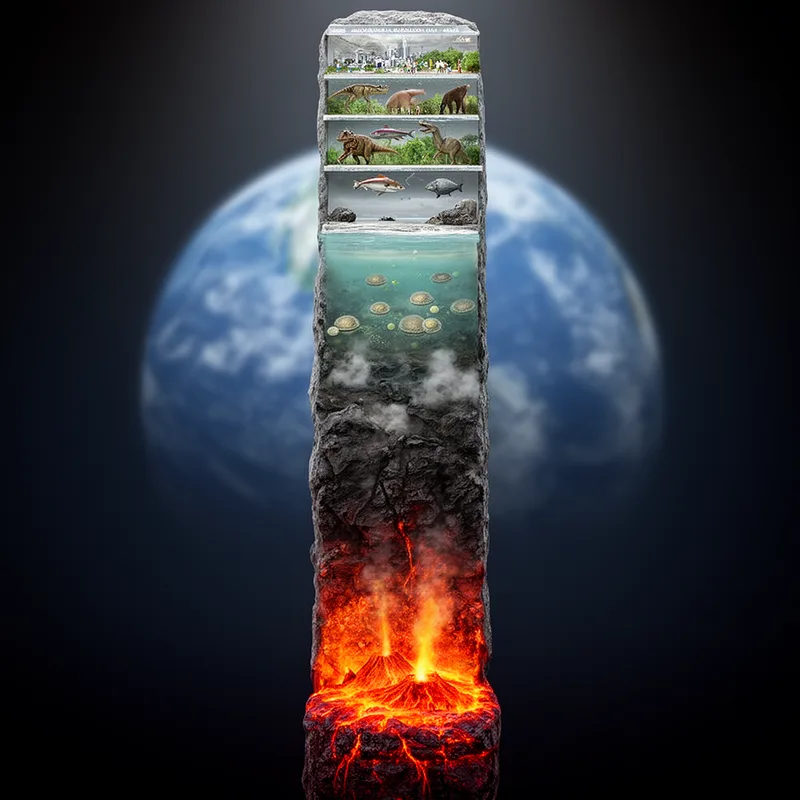
Precambrian eon
- noun
- /priˈkæmbriən ˈiːɒn/
- Specialized
- The Precambrian eon represents nearly 90% of Earth's geological history.
Examples
-
During the Precambrian eon, life was primarily unicellular.
-
Many of the oldest rocks on Earth formed during the Precambrian eon.
-
Fossils from the Precambrian eon are extremely rare due to the simple life forms that existed then.
-
The Precambrian eon lasted for billions of years.
-
Fossils from the Precambrian eon are extremely rare due to the simple life forms that existed then.
-
Many of the oldest rocks on Earth formed during the Precambrian eon.
-
The Precambrian eon represents nearly 90% of Earth's geological history.
Synonyms

A very long part of Earth's history from about 3.8 billion to 544 million years ago

A very long time in Earth's early history with only very simple life like bacteria
Surface Forms
Morphology
The phrase is fully compositional: 'Precambrian' names a particular geological interval and 'eon' denotes a major division of geological time, so together they straightforwardly mean the eon that is Precambrian. While the term is technical, a learner who knows both constituent words can derive the overall meaning without prior exposure.
Etymology
Precambrian eon comes from the word Precambrian and simply means the very long time 'before the Cambrian'. The later time called Cambrian is when many complex animals first appear, so Precambrian eon is used for Earth's earliest history, long before those animals.

