
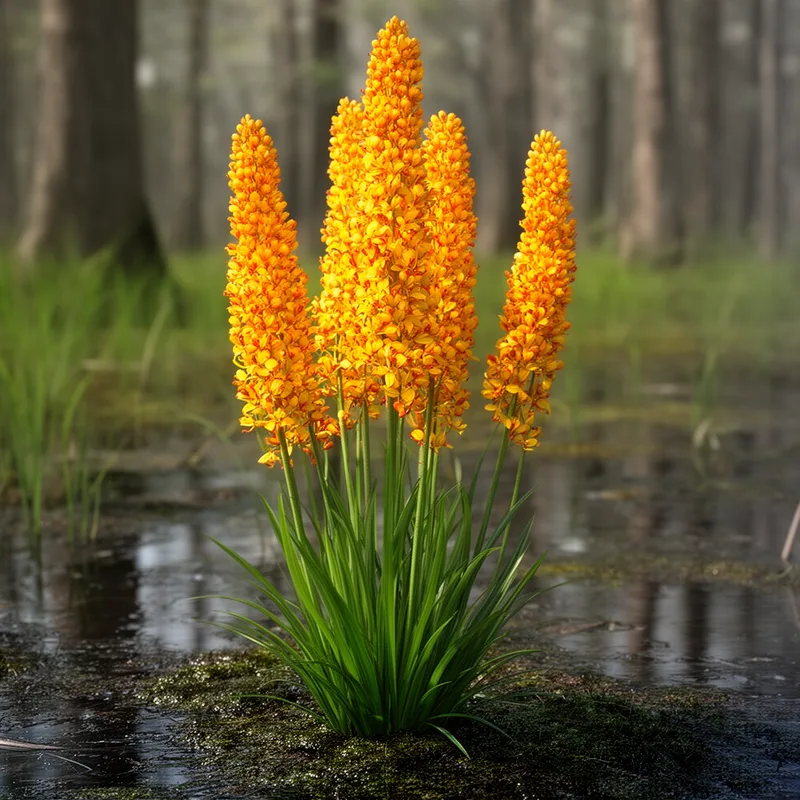
Polygala lutea
- noun
- Specialized
- The rare Polygala lutea thrives in boggy areas of the southeastern United States.
Examples
-
We studied Polygala lutea because of its striking yellow-orange flower spikes.
-
Conservationists are concerned about habitat loss affecting native species like Polygala lutea.
-
Look at that Polygala lutea!
-
What a stunning Polygala lutea!
-
The rare Polygala lutea thrives in boggy areas of the southeastern United States.
-
We studied Polygala lutea because of its striking yellow-orange flower spikes.
-
Conservationists are concerned about habitat loss affecting native species like Polygala lutea.
Synonyms

A bog plant with spikes of orange-yellow flowers that grows in the southeastern United States

A small plant that grows in wet sandy areas in the southeastern United States and has spikes of yellow-orange flowers

A plant that grows in bogs and has spikes of yellow-orange flowers
A bog plant with spikes of yellow-orange flowers that grows in the pine barrens
Surface Forms
Morphology
Polygala + lutea
This is a Latin binomial (genus + specific epithet) rather than a compositional English phrase; knowing 'Polygala' only signals it is a plant genus but the detailed meaning (bog plant, habitat, and yellow‑orange flowers) depends on botanical/Latin knowledge that a B1 learner will not have. The second constituent 'lutea' is not attested in the learner dictionary and its Latin meaning ('yellow') is not accessible to most learners, so the overall sense is not derivable from the parts.
Etymology
The plant name Polygala lutea comes from old Greek and Latin words: Polygala combines words for 'many' and 'milk' because people once thought some related plants helped produce milk, and lutea is Latin for 'yellow', which describes its flowers. So the name tells you it is a yellow-flowered plant and hints at the old idea about milk.

