
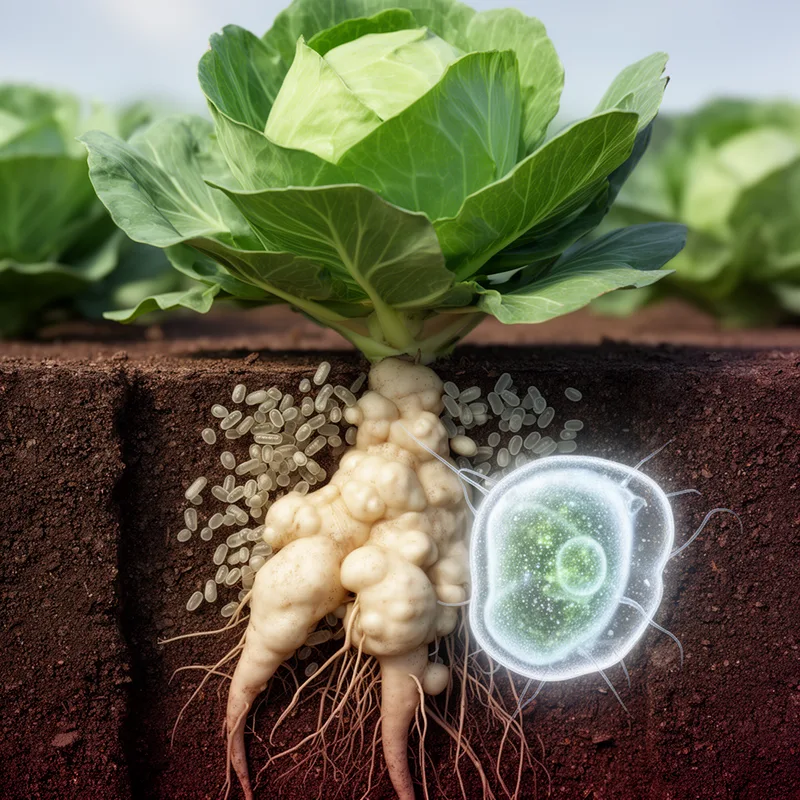
Plasmodiophora brassicae
- noun
- /plæzˌmoʊdiəˈfɔːrə bræsɪˈkeɪ/
- Specialized
- Researchers are studying how Plasmodiophora brassicae infects cabbage roots to develop resistant cultivars.
Examples
-
Careful crop rotation can help manage the spread of Plasmodiophora brassicae in vegetable gardens.
-
The soil in the field was contaminated with Plasmodiophora brassicae, leading to a severe outbreak of clubroot.
-
Farmers should learn about Plasmodiophora brassicae to prevent crop loss.
-
The Plasmodiophora brassicae infection can severely affect cabbage yields.
-
Researchers are studying how Plasmodiophora brassicae infects cabbage roots to develop resistant cultivars.
-
The soil in the field was contaminated with Plasmodiophora brassicae, leading to a severe outbreak of clubroot.
-
Farmers should learn about Plasmodiophora brassicae to prevent crop loss.
Synonyms

A soil fungus that makes cabbage or broccoli roots swell and plants weak

A tiny living thing that infects plants and causes clubroot disease in cabbages
Surface Forms
Morphology
Plasmodiophora + brassicae
The name is compositional in a scientific way: 'Plasmodiophora' denotes a plant-pathogenic microorganism and the species epithet 'brassicae' indicates association with Brassica (i.e. ‘‘of brassica’’), so a learner who recognises the Brassica root or Latin genitive can infer it is the Plasmodiophora that affects brassica plants. However, understanding this requires familiarity with scientific binomial naming or the brassica root, which is specialist knowledge beyond an average B1 learner, so the relation is only partially transparent.
Etymology
Plasmodiophora brassicae is a scientific name made of two parts: Plasmodiophora suggests a shape-changing tiny mass and brassicae means 'of cabbages'. So the name points to a tiny organism that attacks cabbage roots and causes 'clubroot'.

