

Pinus parryana
- noun
- Specialized
- Researchers observed that Pinus parryana sometimes bears only three or four needles per bundle due to hybridization.
Examples
-
The Pinus parryana thrives in the dry, rocky hillsides of southern California.
-
The Pinus parryana produces edible seeds that are a vital food source for many wildlife species.
-
Many birds rely on the seeds of Pinus parryana for food in their natural habitat.
-
Look at that beautiful Pinus parryana!
-
The Pinus parryana thrives in the mountainous regions of southern California.
-
Scientists studied how Pinus parryana can adapt by developing three or four needles due to hybridization.
-
In its natural environment, the Pinus parryana is often found growing on dry, rocky slopes.
Synonyms
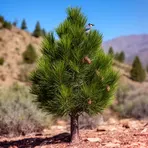
A small pine tree with mostly five needles in a group that grows in southern California and northern Baja California
Surface Forms
Morphology
Pinus + parryana
The element 'Pinus' clearly signals the genus (pines), so a learner who knows that could infer the phrase denotes a kind of pine; however 'parryana' is a non-lexical species epithet (from a proper name) with no predictable semantic contribution. Therefore a B1 learner could guess it names a species of pine but cannot derive the specific identity or traits from the parts, making it only partially transparent; taxonomic Latin binomials are conventionally meaningful across languages, which supports this limited inference.
Etymology
Pinus parryana is the scientific name for a kind of pine. The first part, Pinus, means 'pine' and the second part, parryana, likely comes from the name of the plant collector Charles Parry, so the name simply means 'Parry's pine' and tells us who the tree honors.

