

Phoradendron flavescens
- noun
- /ˌfɔːrəˈdɛndron fləˈvɛsəns/
- Specialized
- Phoradendron flavescens can weaken oak trees by parasitizing their branches.
Examples
-
Unlike European mistletoe, Phoradendron flavescens is native to North America and grows on deciduous trees.
-
During the holidays, many people hang Phoradendron flavescens in their homes as the American mistletoe.
-
The Phoradendron flavescens is often seen during the holiday season.
-
Many people hang Phoradendron flavescens in their homes for Christmas.
-
Phoradendron flavescens is a type of mistletoe that can significantly weaken the trees it grows on.
-
During Christmas, it is common to find Phoradendron flavescens hanging in homes as a festive decoration.
-
In North America, Phoradendron flavescens grows primarily on deciduous trees and is associated with holiday traditions.
Synonyms

 40
4.1
40
4.1

A small green plant with white berries that people hang in doorways at Christmas

A small plant that grows on trees and is used for Christmas decorations and can weaken the tree
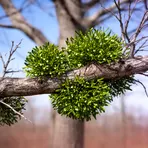
A group of American plants like mistletoe that grow on trees and take water and food from them
Surface Forms
Morphology
Phoradendron + flavescens
This is a Latin binomial (genus + species). A learner who knows 'Phoradendron' as a tree‑attaching plant can infer the phrase refers to a type of that plant (i.e., a mistletoe), but the species epithet 'flavescens' is undefined here and species‑specific cultural connotations (Christmas association, impact on host) are not derivable from the parts. Because the genus signals the general category but the full, culture‑specific meaning and the second element are not transparently informative to a B1 learner, the expression is only partially transparent.
Etymology
Phoradendron flavescens gives a clear picture: Phoradendron means 'on a tree' and flavescens means 'yellowish', so think of a pale mistletoe living on branches. That's why the name refers to the American mistletoe people hang at Christmas and to a plant that takes water and food from the tree and can weaken it.