

Peloponnesian
 1
9.5
1
9.5

- adjective
- /ˌpɛləpəˈniːʒən/
- Now, along with your skiing and swimming, I hope you found time to enlighten yourselves about the Peloponnesian War and its implications for today.
- Peloponnesian War
Loading YouTube…
Watch on YouTubeAnd then we have Thucydides, who writes about the Peloponnesian Wars after he's sidelined as a general.
- And then we have Thucydides, who writes about the Peloponnesian Wars after he's sidelined as a general.
- And they don't visualize him as a heavy infantryman who fought in at least three major battles of the Peloponnesian War.
- Thucydides, the guy who wrote the history of the the Peloponnesian War dies, leaving this account behind.
- One of my favorite books of all time happens to be this, the the city's history of the Peloponnesian War.
Examples
-
The tragedy of Athens in Thucydides' Peloponnesian War lies in democracy's difficulty in withstanding the pressures of imperial necessity, compulsions that corrupt and even destroy the freedoms at the root of democracy.
Academic text (2004) -
Socrates was a soldier in the Athenian army during the Peloponnesian War, as he tells us in The Apology.
Academic text (1998) -
And now, the Peloponnesian War.
-
History of the Peloponnesian War.
Fiction book (1999) -
The crisis which will produce the Great Peloponnesian War has already begun.
-
If you do, we will leave the Peloponnesian League and join the Athenian side.
-
Take, for example, Donald Kagan's analysis of the Peloponnesian Wars.
Academic text (1990) -
Near the end of the first year of the Peloponnesian War, the people of Athens conducted a funeral to honor those fellow citizens who had fallen in battle.
Academic text (2004) -
One of the greatest historians of all time, Thucydides, for example, never loses sight of suffering in The Peloponnesian War.
Academic text (1993) -
The Peloponnesian War was a significant conflict between Sparta and Athens.
Compounds

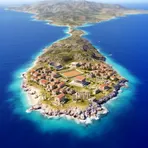
A large piece of land in southern Greece that has sea on three sides and ancient cities like Sparta
Surface Forms
Morphology
Peloponnesian = Peloponnese (transparent) = Peloponnese + ian
Formed by adding the productive adjectival suffix '-ian' to the place name 'Peloponnese', a transparent relation for learners who know the place name.
Etymology
Peloponnesian comes from the place name Peloponnese, which itself comes from the Greek hero name Pelops plus -nesos meaning 'island', so it originally meant 'Pelops' island'. So, Peloponnesian means 'from or about the Peloponnese', a large peninsula in southern Greece.