

Paleo-Indian culture
- noun
- /ˈpeɪlioʊ ˈɪndɪən ˈkʌltʃər/
- Specialized
- The use of distinctive spear points is a hallmark of the Paleo-Indian culture.
Examples
-
The Paleo-Indian culture thrived during the late Pleistocene.
-
Many archaeologists study the Paleo-Indian culture to understand the migration patterns of early humans in the Americas.
-
Artifacts from the Paleo-Indian culture have been found across both North and South America.
-
Many artifacts from the Paleo-Indian cultures have been discovered.
-
Artifacts from the Paleo-Indian culture have been found across both North and South America.
-
Many archaeologists study the Paleo-Indian culture to understand the migration patterns of early humans in the Americas.
-
The use of distinctive spear points is a hallmark of the Paleo-Indian culture.
Synonyms

The way of life of the earliest people in North and South America
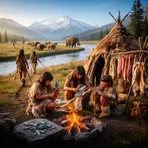
The way of life of the earliest people who lived in North and South America

A time in human history before people wrote things
Surface Forms
Morphology
Paleo-Indian + culture
The compound 'Paleo-Indian' is a technical, culture-historical label (paleo- + Indian) that most B1 learners would not be able to parse or infer from the ordinary words; 'culture' is general but does not supply the necessary historical/archaeological sense. Because the key constituent is specialized and requires background knowledge of prehistoric peoples and the prefix 'paleo-', the overall meaning is not derivable by a learner who only knows the surface words.
Etymology
Paleo-Indian culture comes from two parts: Paleo, meaning 'very old', and Indian, the old name early explorers used for the native peoples of the Americas. So, the name points to the very first people, hunters and gatherers, who lived in the Americas long ago.

