
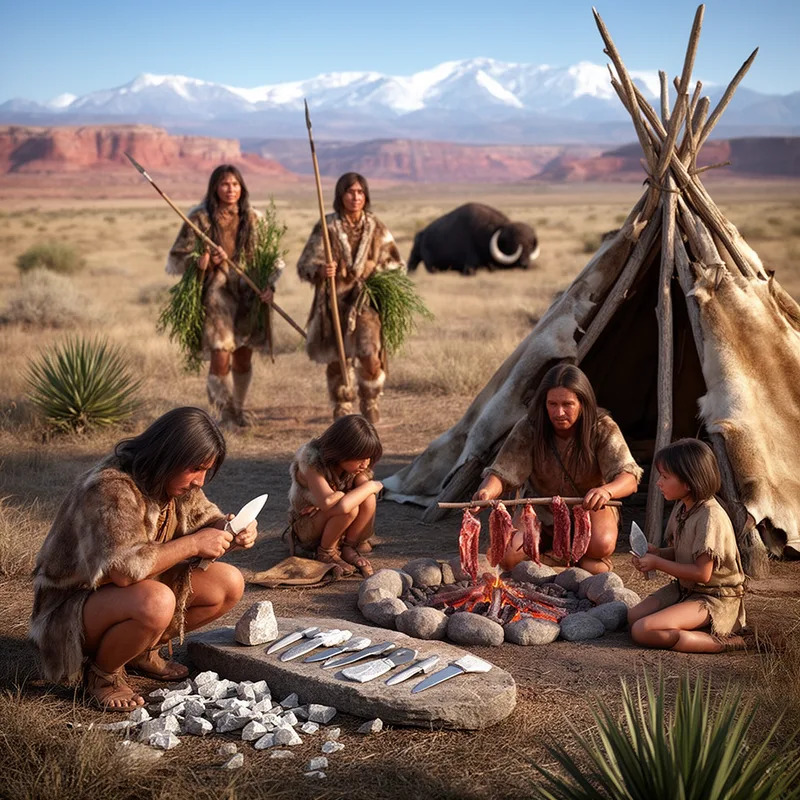
Paleo-American culture
- noun
- /ˈpeɪlioʊ əˈmɛrɪkən ˈkʌltʃər/
- Specialized
- The study of Paleo-American culture helps us understand the migration patterns of early humans into the Americas.
Examples
-
Many sites associated with Paleo-American culture contain distinctive stone tools and hunting implements.
-
Archaeologists discovered new artifacts that shed light on Paleo-American culture in the southwestern United States.
-
The Paleo-American culture thrived thousands of years ago.
-
Many artifacts from the Paleo-American cultures have been discovered.
-
Archaeologists discovered new artifacts that shed light on Paleo-American culture in the southwestern United States.
-
The study of Paleo-American culture helps us understand the migration patterns of early humans into the Americas.
-
Many sites associated with Paleo-American culture contain distinctive stone tools and hunting implements.
Synonyms

The way of life of the earliest people who lived in North and South America

People who first lived in the Americas and hunted with stone tools
Surface Forms
Morphology
Paleo-American + culture
The phrase is compositionally built as ‘Paleo-American’ (people from ancient/early America) + ‘culture’ (shared practices), so the overall sense — the culture of the earliest Americans — is directly derivable if the modifier is understood. However, ‘Paleo-’ is a technical, bound prefix that B1 learners typically do not know, so the expression is only partially transparent: the head noun is clear but the modifier requires specialized morphological or archaeological knowledge.
Etymology
Paleo-American culture comes from paleo (a word meaning 'very old') and American, so it names the very early people of the Americas. Imagine early hunters long ago using simple stone tools, and that's why the phrase means the ancient cultures of North and South America.

