
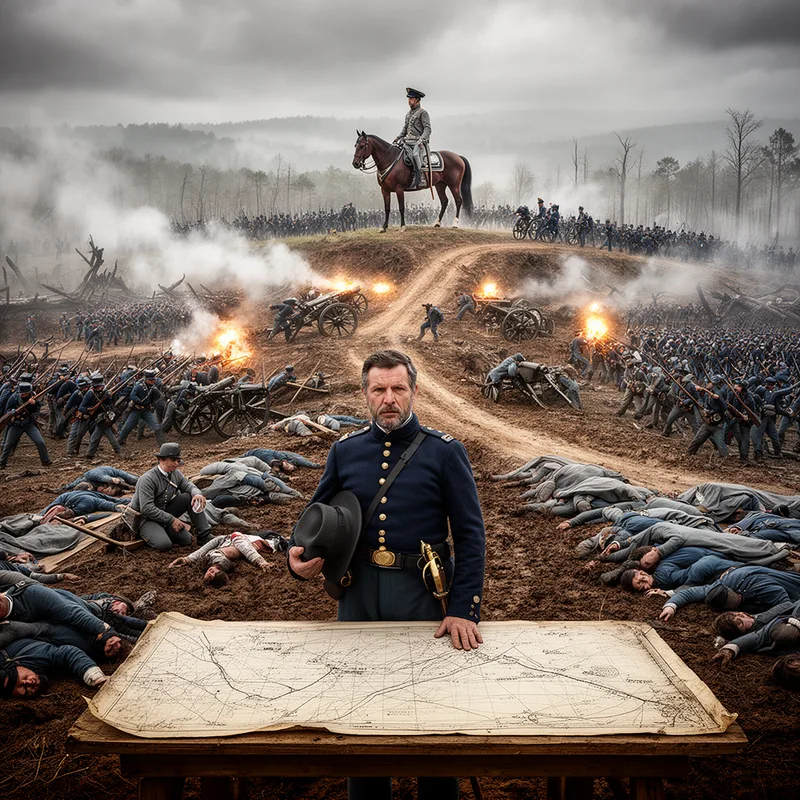
Overland Campaign
- noun
- /ˈoʊvərˌlænd kæmˈpeɪn/
- Historians often discuss the high cost in lives during the Overland Campaign.
Examples
-
The Overland Campaign was crucial in wearing down Confederate forces during 1864.
-
General Grant's strategy in the Overland Campaign changed the course of the Civil War.
-
The Overland Campaign was a pivotal moment in American history.
-
Many historians study the Overland Campaign for its strategic significance.
-
The Overland Campaign was a turning point in the American Civil War, showcasing the determination of Union forces.
-
In the Overland Campaign of 1864, both sides experienced significant casualties as they fought for control of Virginia.
-
General Grant's tactical decisions during the Overland Campaign often put pressure on Lee's Confederate forces.
Synonyms

A series of 1864 Civil War battles between Grant and Lee fought in thick forest with heavy losses
Surface Forms
Morphology
The components 'overland' (by land) and 'campaign' (a planned set of actions, often military) transparently combine to indicate a campaign conducted over land, so a B1 learner who knows the words can infer the general idea. However, the capitalized phrase refers to a specific historical series of battles in 1864 (with details about leaders and casualties) that cannot be deduced from the parts alone and requires world knowledge, so the expression is only partially transparent.
Etymology
Overland Campaign gets its name from the image of armies moving over the land on long marches and fighting battle after battle instead of going 'by sea'. In the American Civil War of 1864, General Grant led a long series of such battles across Virginia that slowly wore down the enemy but caused heavy losses and no clear winner, so the name now means a long, costly set of battles.

