

Old World least weasel
- noun
- /oʊld wɜrld list ˈwiːzəl/
- UK
 :
mustélido menor de los viejos mundos
:
mustélido menor de los viejos mundos
- The Old World least weasel is the smallest carnivorous mammal in the world.
Examples
-
During winter, the fur of the Old World least weasel turns white, aiding its camouflage in snowy environments.
-
Farmers often appreciate the presence of the Old World least weasel for its role in controlling rodent populations.
-
The Old World least weasel is known for its agility.
-
I saw an Old World least weasel in the forest.
-
During winter, the fur of the Old World least weasel turns white, aiding its camouflage in snowy environments.
-
Farmers often appreciate the presence of the Old World least weasel for its role in controlling rodent populations.
-
The Old World least weasel is the smallest carnivorous mammal in the world.
Synonyms
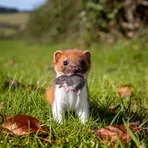
A very small weasel that eats small animals in Europe, Asia and North America
Surface Forms
Morphology
This is a directly compositional noun phrase: 'least weasel' transparently means the smallest kind of weasel and 'Old World' functions as a geographic modifier (the traditional Old World vs New World distinction). The meaning — a small weasel species found in the Old World (Europe/Asia/Africa) — follows normal modifier + noun composition and is likely recoverable by a B1 learner who knows the constituent words.
Etymology
Old World least weasel comes from a simple picture: Old World means Europe and Asia, least means 'very small', and weasel is a small meat-eating animal. So the name simply points to a very small weasel that lives in Europe and Asia.

