
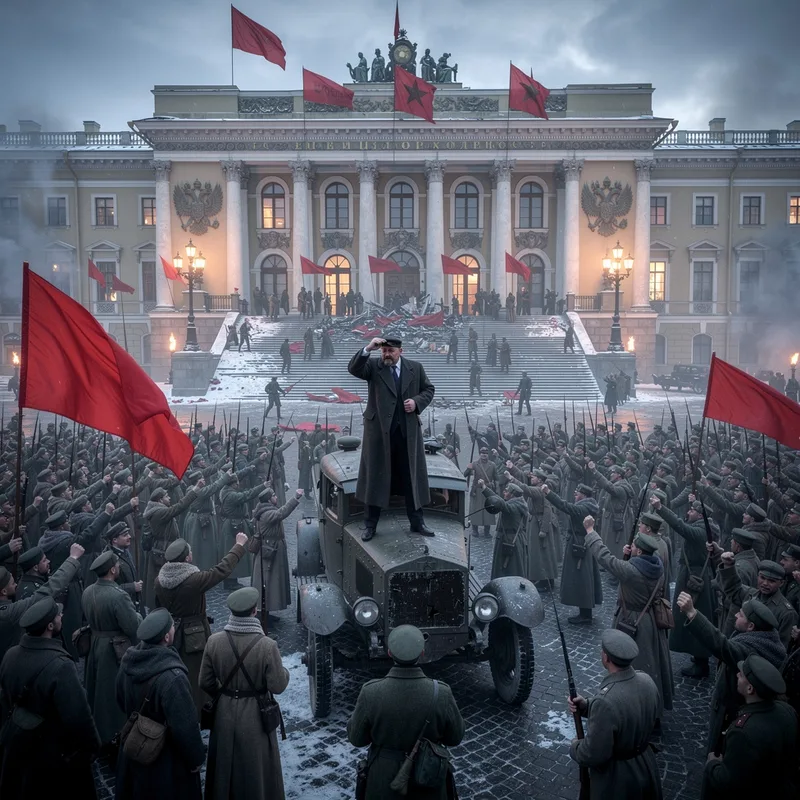
October Revolution
 1
7.3
1
7.3

- noun
- /ɒkˈtoʊbər ˌrɛvəˈluːʃən/
- The tenets of Marxism were put into practice following the October Revolution led by Lenin.
Loading YouTube…
Watch on YouTubeAnd he was the first Russian leader to be born after the October Revolution.
- And he was the first Russian leader to be born after the October Revolution.
- Within a month after the October Revolution, there was an assault by Bolshevik Red Army forces on Kiev to overthrow the the Radi government.
- And I call the October coup, as many other historians call the October Revolution, happened after the seizure of power.
- The plans would develop all winter, and a developing story right now was Russia's October Revolution.
Examples
-
The October Revolution ushered the Bolsheviks into power, who espoused a radical domestic agenda and a firebrand "revisionist" rhetoric directed against the international status quo.
Academic text (2001) -
They are so authoritarian and aggressive, exactly as the Bolsheviks were during the decisive days of the October Revolution.
Blog text (14) -
Who was the brilliant leader of the Great October Revolution?
-
It's about the October Revolution.
-
The victory of the Soviet Union over Hitler was the achievement of the regime of the October Revolution.
Blog text (22) -
Trotsky thought World Revolution was underway with the October Revolution in 1917.
Blog text (29) -
Within a month after the October Revolution, there was an assault by Bolshevik Red Army forces on Kiev to overthrow the the Radi government.
-
In explaining the background of the Russian Revolution and its lessons, Lenin, in Chapter Three of "Left-Wing" Communism, discusses the history of Bolshevism from 1903 until the October Revolution in 1917.
Blog text (22) -
The October Revolution of 1917 marked the collapse of the Russian Provisional Government.
-
Many historians agree that the October Revolution fundamentally changed the course of Russian history.
Synonyms
 2
4.1
2
4.1
A revolution in November 1917 when Lenin's supporters overthrew the government and set up Soviet rule
Surface Forms
Morphology
The phrase is compositionally predictable in that it literally denotes a revolution associated with the month of October, so a B1 learner who knows 'October' and 'revolution' can infer it refers to a revolution occurring in October. However, as a conventional name for a specific historical event (the 1917 Bolshevik overthrow in Russia, with calendar-name quirks) the full, precise historical meaning requires world knowledge beyond the constituent words, making it only partially transparent.
Etymology
October Revolution got its name from the old Russian calendar: the big 1917 uprising happened in what people there called October, even though in our calendar it was November. The phrase refers to the Bolsheviks' overthrow of the government and so means the 1917 event that began 'communist rule' in Russia.