
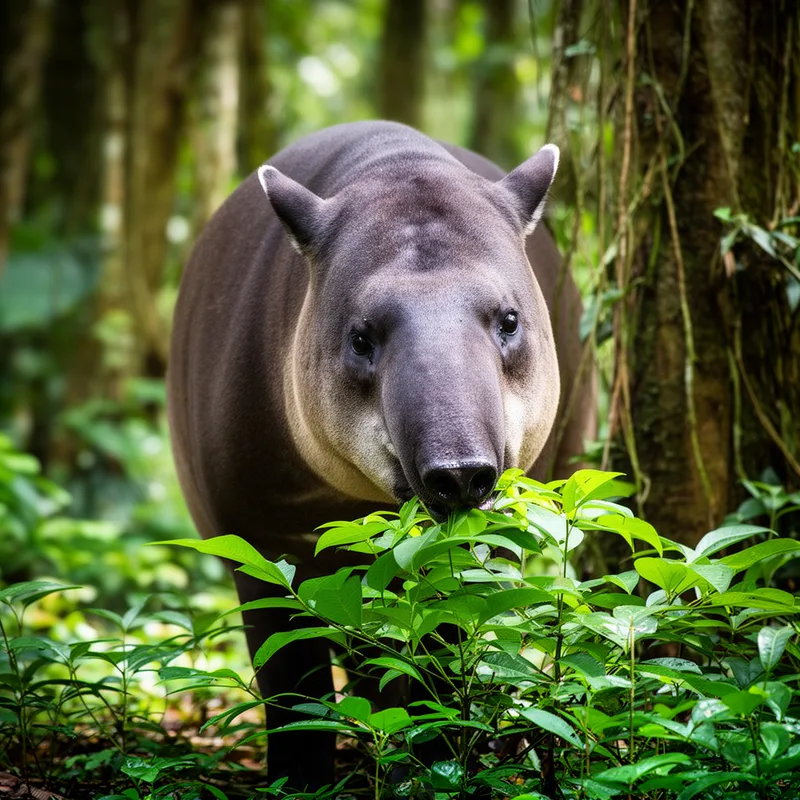
New World tapir
- noun
- /nuː wɜrld ˈteɪpɪr/
- Specialized
- The New World tapir is often seen in rainforest habitats across Brazil and Colombia.
Examples
-
Many New World tapirs are endangered due to habitat loss.
-
Unlike the Malayan tapir, the New World tapir has a uniform dark coloring.
-
Researchers study how the New World tapir adapts to different environments in Central America.
-
The New World tapir is often found in tropical forests.
-
The New World tapir is often seen in rainforest habitats across Brazil and Colombia.
-
Researchers study how the New World tapir adapts to different environments in Central America.
-
Many New World tapirs are endangered due to habitat loss.
Synonyms
 3
8.2
3
8.2

A large mammal with a flexible nose that lives in tropical forests and is active at night
Surface Forms
Morphology
The phrase is largely compositional: combining 'New World' (a conventional term for the Americas) with 'tapir' signals a tapir native to the Americas, so the constituents point to a geographic subtype. However, 'New World' is a conventional proper-name contrast with 'Old World' that not all B1 learners will know, so the meaning is only partially predictable without prior exposure.
Etymology
New World tapir names the kind of tapir that lives in the Americas. The part New World was used by European explorers for the Americas, so New World tapir means a tapir from Central or South America rather than one from the 'Old World'.