

Neolithic Age
- noun
- /niˈɒlɪθɪk eɪdʒ/
- Pottery and weaving became common practices during the Neolithic Age, marking advancements in technology.
Examples
-
Evolutionists refer to this period as the Neolithic Age or the last part of the Stone Age.
Blog text (26) -
And yes, I would love to win the favorite turkey tools since what I am using are ancient tools designed by someone from the Neolithic age.
Blog text (27) -
In the span of time humans have been on the planet, the Neolithic age is but a blink.
Blog text (32) -
Early contacts developed during the Mesolithic and Neolithic ages, between the Uralic foragers of the north and the non-Indo-European population of the south.
Academic text (2000) -
The invention of farming during the Neolithic Age changed the way humans lived permanently.
-
During the Neolithic Age, people began to settle in one place, leading to the establishment of permanent villages.
Synonyms

 1
8.4
1
8.4

The latest part of the Stone Age when people begin farming, keep animals, and make polished stone tools
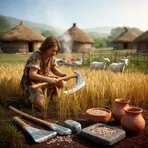
A later part of the Stone Age when people begin farming and make polished stone tools
How Advanced


Surface Forms
Morphology
The meaning is compositionally derived from 'neolithic' (relating to the final phase of the Stone Age) + 'age' (a historical period), so a learner who knows both words can infer it denotes the period associated with the Neolithic. The pattern (e.g. 'Neolithic Age' / 'Edad Neolítica' / 'Âge néolithique') is cross-linguistically common, making the expression transparent.
Etymology
Neolithic Age comes from Greek words neo ('new') and lithic ('stone'), so it literally means 'new stone'. People began farming and making smoother stone tools then, so the name is used for the last part of the Stone Age when people started living in villages.