
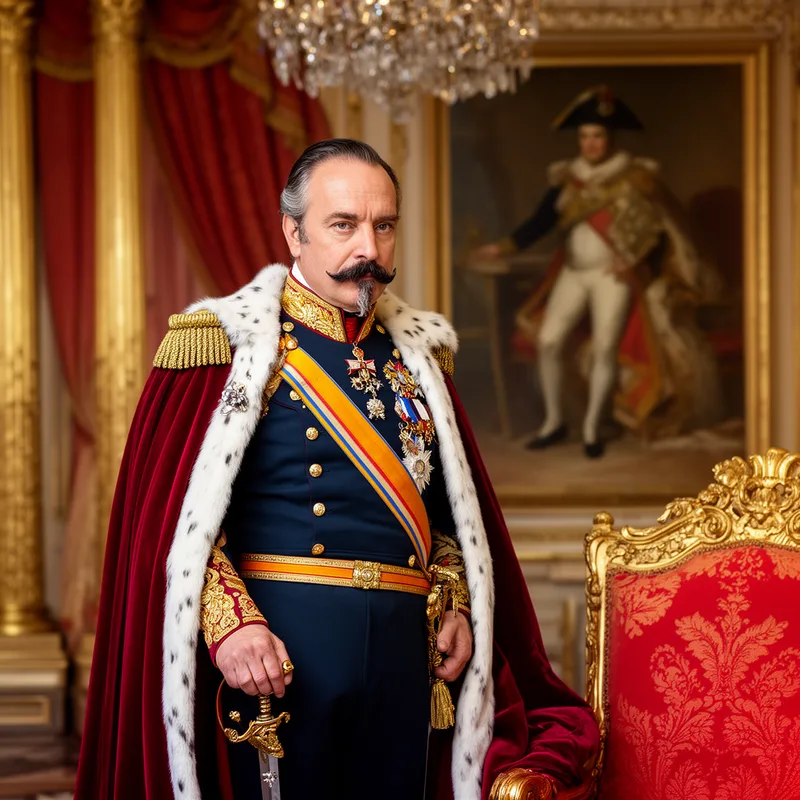
Napoleon III
 1
6.2

- proper noun
- Charles Louis Napoleon Bonaparte, known as Napoleon III, ruled France as emperor from 1852 until 1870.
- Napoleon III and Empress Eugenie
- proclaimed Napoleon III
Examples
-
Napoleon III was a significant historical figure.
-
Sadly, the Franco-Prussian War led to the downfall of Napoleon III and the collapse of the Second Empire.
-
Napoleon III ruled France during the turbulent years of the Second Empire.
-
Historians often debate the political strategies of Napoleon III.
-
The defeat of Napoleon III in 1870 marked the end of his reign.
-
Don't forget about Napoleon III!
-
On December 2, 1852, Louis Napoleon was proclaimed Napoleon III, marking the establishment of the Second Empire.
Synonyms


 1
7.4
French emperor from 1852 to 1871 who was nephew of Napoleon I
 1
8.9
A nephew of Napoleon I who ruled France as Emperor from 1852 to 1871
Surface Forms
Morphology
This is compositionally transparent: 'Napoleon' is a personal name and 'III' is the Roman numeral for three, so a learner who knows both parts can readily infer 'Napoleon the Third' — i.e. a later historical person with that name. Specific historical facts (exact dates or relation to Napoleon I) require background knowledge, but the basic identity and ordinal meaning are directly derivable and cross-linguistically common.
Etymology
Napoleon III is the name Louis-Napoleon Bonaparte used to show he followed his famous uncle Napoleon, and the III means 'the third' with that name. He was the nephew of Napoleon I and ruled France as emperor from 1852 to 1871, so today Napoleon III means that French ruler from the 1800s.