

Myxobacteriales
- noun
- /mɪksoʊbɒkˈtɛriˌeɪliz/
- Specialized
- Myxobacteriales are studied for their unique gliding motility and ability to form fruiting bodies.
Examples
-
Scientists have discovered new antibiotics produced by members of the Myxobacteriales order.
-
The complex social behavior of Myxobacteriales distinguishes them from many other bacteria.
-
The study focused on Myxobacteriales and their unique social behaviors.
-
Researchers discovered that Myxobacteriales can form fruiting bodies.
-
Myxobacteriales are known for their ability to form multicellular fruiting bodies during their life cycle.
-
Researchers have found that the social behaviors of Myxobacteriales help them survive in various environments.
-
Studies show that Myxobacteriales possess unique gliding motility, which aids in their movement.
Synonyms

A group of soil bacteria that move together and form fruiting bodies
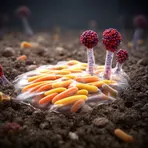
A group of soil bacteria that move by gliding and form fruiting bodies

A group of bacteria that live and move together and make fruiting bodies

A group of bacteria that move together and form fruiting bodies

Bacteria that make slimy groups and live in wet soil or rotting plants
Compounds
- Specialized
A group of soil bacteria that move by gliding and form fruiting bodies
Surface Forms
Morphology
Myxobacteriales = Myxobacteria (semi-transparent) = myxo + bacteria + ales
Contains the recognizable element 'bacteria' so learners can infer it's a group of bacteria, but the taxonomic suffix '-ales' and the combining form 'myxo-' are technical, so the precise meaning (an order-level taxon) is not obvious to general learners.
Etymology
Myxobacteriales comes from myxo-, meaning 'slime', plus bacteria, meaning tiny living cells, and the ending -ales that marks it as an order. So the name means 'slime bacteria order', which fits these bacteria because they move in slimy groups and even make fruiting bodies together.

