
Mycobacteriaceae
- noun
- /ˌmaɪkoʊbækˈtɪəriˌeɪsiː/
- Specialized
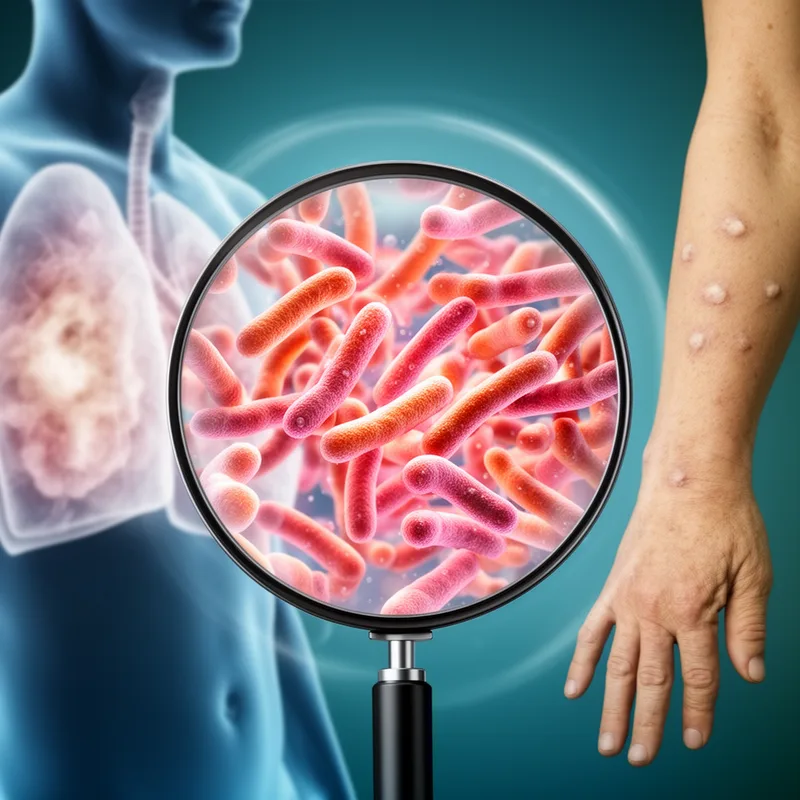
- Mycobacteriaceae include the bacteria responsible for both tuberculosis and leprosy.
Examples
-
Scientists are studying the resistance patterns of Mycobacteriaceae to new antibiotics.
-
Researchers are studying Mycobacteriaceae to find new treatments for leprosy.
-
Members of the Mycobacteriaceae family can be found in a variety of environments.
-
The Mycobacteriaceae family includes the bacteria responsible for tuberculosis.
-
Mycobacteriaceae include the bacteria responsible for tuberculosis and leprosy.
-
The Mycobacteriaceae family is known for its role in causing serious diseases in humans.
-
Researchers are investigating the effects of Mycobacteriaceae on public health around the world.
Synonyms


 1
9.7
A group of long, thin bacteria that includes types living on dead material and types causing diseases like tuberculosis
Surface Forms
Morphology
Mycobacteriaceae = Mycobacterium (semi-transparent) = Mycobacterium + aceae
Formed from the genus name 'Mycobacterium' with the taxonomic family suffix '-aceae'; the formation is regular in scientific nomenclature but the suffix is specialized and may be unfamiliar to general learners.
Etymology
The word Mycobacteriaceae breaks into three parts: myco- meaning 'fungus' because these bacteria once looked like fungi, bacteri- meaning 'rod' like in bacteria, and the ending -aceae meaning 'family'. So, Mycobacteriaceae is the family of fungus-like, rod-shaped bacteria that includes the germs that cause tuberculosis and leprosy.