

Mustela rixosa
- noun
- Specialized
- The Mustela rixosa is the smallest member of the weasel family found in North America.
Examples
-
Unlike larger weasels, Mustela rixosa can squeeze into very narrow burrows.
-
Biologists observed Mustela rixosa hunting voles in the grasslands of Manitoba.
-
The Mustela rixosa is known for its small size.
-
Is the Mustela rixosa endangered in its habitat?
-
Biologists observed Mustela rixosa hunting voles in the grasslands of Manitoba.
-
The Mustela rixosa is the smallest member of the weasel family found in North America.
-
Unlike larger weasels, Mustela rixosa can squeeze into very narrow burrows.
Synonyms

A very small wild mammal in Canada and northeastern United States that turns white in winter
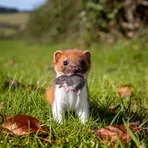
A very small weasel that eats small animals in Europe, Asia and North America
Surface Forms
Morphology
Mustela + rixosa
The name is partly compositional: 'Mustela' is a taxonomic genus so a learner who recognises that can infer the phrase refers to a species of weasel. However, the specific epithet 'rixosa' has no obvious English meaning (and is not glossed here), so the precise sense "least weasel" and the native-range information cannot be derived from the constituents alone. This partial inferability (genus-level transparency but opaque species epithet) makes the expression only partially predictable to a B1 learner.
Etymology
Mustela rixosa comes from old Latin words: Mustela means 'weasel' and rixosa may mean 'rowdy' or 'quarrelsome', creating the image of a small, bold animal. That's why the name fits this tiny North American weasel that can squeeze into narrow burrows and hunt small prey.

