

Mustela


 1
9.9
1
9.9
- proper noun
- /ˈmʌstələ/
- Specialized
- MUSTELA ARMENIA-- MEMBER OF THE WEASEL FAMILY.
Examples
-
For example, on Baltic Sea islands, birds shifted their selection of breeding sites in the presence of introduced American mink (Mustela vison) because of predation risk.
Academic text (2009) -
The three Northern Hemisphere species grade in size from large (Mustela frenata) through medium (M. erminea) to small (M. nivalis).
Academic text (1991) -
There are those that are definitely acknowledged to exist by scientists, such as the Mustela africana, a small weasel with a stripe on its stomach, but specimens of which are very rarely seen.
Fiction book (1993) -
An epizootic catarrhal enteritis (ECE) was first recognized in domestic ferrets (Mustela putorius furo) in the United States in 2000.
Academic text (2014) -
Most pet owners are familiar with Mustela furo, commonly known as the ferret.
-
The black-footed ferret, Mustela nigripes, is one of the rarest mammals in North America.
-
In the scientific classification, Mustela vison refers to the American mink, a member of the weasel family.
Synonyms
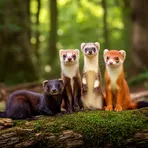
A group of animals that includes minks and weasels
Compounds

- Specialized
A small wild ferret with black feet that lives on grasslands and is almost extinct
- Specialized
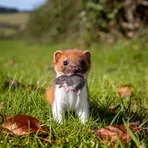
A very small weasel that eats small animals in Europe, Asia and North America

- Specialized
A dark brown mammal like a weasel from Eurasian woods that makes a strong unpleasant smell when threatened

- Specialized
A very small weasel that lives in Canada and the northeastern United States

- Specialized
A small animal that lives near water with dark brown fur from North America

- Specialized
A small animal like a weasel that turns white in winter except for its black tail tip

Surface Forms
Etymology
Mustela is the Latin name mustela meaning 'weasel' and is likely linked to mus 'mouse', giving the idea of a 'little mouse'. This little-mouse image is a handy way to remember the scientific name for weasels, ferrets, and their relatives.