
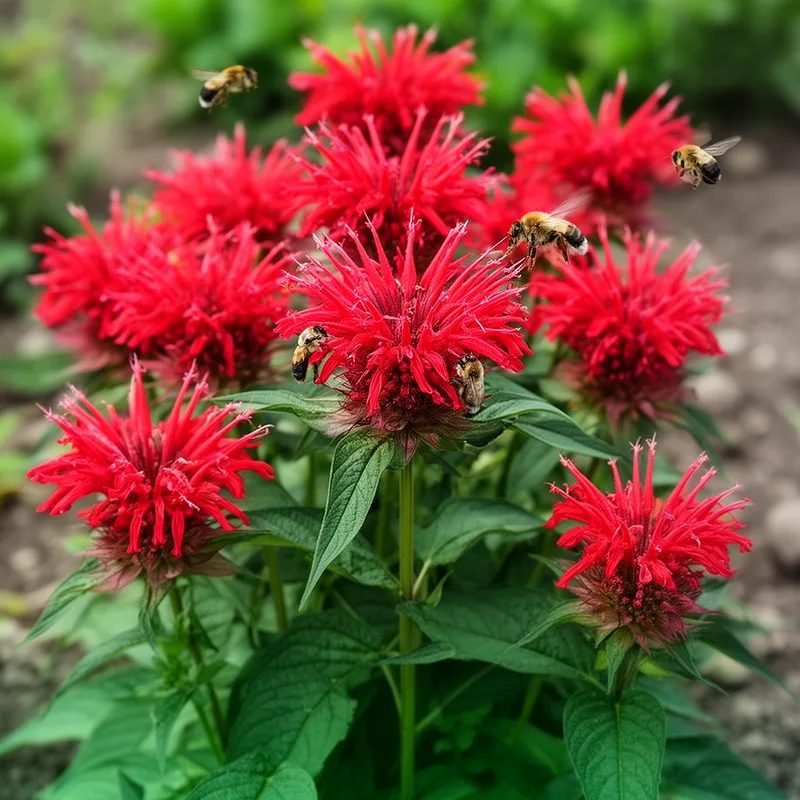
Monarda didyma
- noun
- Specialized
- Herbalists prize Monarda didyma for its aromatic leaves and medicinal properties.
Examples
-
The garden was filled with the vibrant reds of Monarda didyma attracting bees and butterflies.
-
Many gardeners love Monarda didyma for its vibrant colors.
-
Monarda didyma blooms throughout the summer, adding color and fragrance to the landscape.
-
The Monarda didyma blooms beautifully in the summer.
-
Monarda didyma is often referred to as bee balm due to its attraction of pollinators.
-
The striking pink flowers of Monarda didyma enhance the beauty of any garden.
-
Gardeners appreciate Monarda didyma not only for its beauty but also for its pleasant scent.
Synonyms


 1
7.4
1
7.4
A garden herb with bright scented flowers that attract bees and butterflies

A strong smelling plant with bright flowers used to make tea
A garden herb with bright tube-shaped flowers that attract bees and butterflies

A North American plant with purple or pink flowers used for tea and in gardens

A mint plant with a citrus smell often used in teas
Surface Forms
Morphology
monarda + didyma
This is a botanical Latin binomial (genus + species epithet) rather than a compositional English phrase; the second element 'didyma' is not a normal English word and is not listed in the provided dictionary entry. Knowing the constituents (one being a rare genus name and the other unknown) would not allow a B1 learner to infer the meaning 'a perennial aromatic herb', so the expression is non-compositional for typical learners.
Etymology
Monarda didyma honors a 16th-century Spanish doctor, Nicolás Monardes, who wrote about New World plants. People often call it 'bee balm' because bees crowd its bright flowers and 'bergamot' because the leaves smell like the bergamot orange, so the name helps you remember it is a fragrant, bee-loving herb.