

Milky Way
 52
3.7
52
3.7

- proper noun
- /ˈmɪlki weɪ/
- Within the Milky Way, the Earth resides on the inner edge of a spiral arm.
- Milky Way galaxy
- see the Milky Way
- the Milky Way in the sky
Loading YouTube…
Watch on YouTubeBut these are surely within the Milky Way itself.
- But these are surely within the Milky Way itself.
- And that gives us some limit for how old is the Milky Way if that's its oldest star.
- So he knew that the Milky Way didn't seem to be expanding or contracting.
- I would run outside and just lay on the ground under the southern Milky Way, beautiful right up there.
- Now it's going around what we call the galactic plane, that plane of the Milky Way disk.
- They want to change the orbit of our planet, to shift our relationship to the sun and the center of the Milky Way so that we shift our relationship to time.
- That is more stars than there are, that is more than the number of stars that are in the in the Milky Way.
- Some people estimate millions, even billions just in our own Milky Way Galaxy.
- But, you know, we we may well be the only ones in our Milky Way Galaxy.
- The dark matter in our own Milky Way Galaxy is just passing through US right now.
- So if you move at a fraction of the speed of light, then you can reach greater distances beyond the Milky Way Galaxy.
Examples
-
For the ancient Greeks and Romans, the Milky Way was also heaven's Main Street.
Academic text (1991) -
Shortly after dark in the fall, we can see the Milky Way crossing overhead.
Academic text (1991) -
I would run outside and just lay on the ground under the southern Milky Way, beautiful right up there.
-
See, our sun is one star in the Milky Way galaxy.
-
The sun is one of 200 billion stars here in the Milky Way galaxy.
-
Now these stars that we're exploring are in the Milky Way and that's really our local cosmic neighborhood.
-
And in fact, if you look in our Milky Way Galaxy with telescopes, you see big clouds of gas and dust.
-
Yakuts in Siberia say the Milky Way is another kind of trail.
Academic text (1991) -
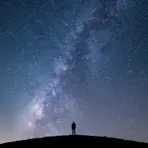
On clear nights, the Milky Way can be seen as a bright band of light stretching across the sky.
-
Astronomers study the Milky Way to understand the formation of galaxies.
Synonyms
 2
3.5
2
3.5
A large group of stars that contains the solar system and looks like a faint milky band in the sky
How Bright


Surface Forms
Morphology
The phrase literally combines 'milky' (milk-like) and 'way' (path), so a B1 learner who knows both words can infer it refers to a pale, band-like path — i.e. a milky-looking feature in the sky. However, the specific astronomical sense as the name of our galaxy (containing the solar system) is a conventionalized, proper-name meaning that goes beyond the simple literal composition and may not be fully predictable without prior exposure.
Etymology
Milky Way may come from the way the bright band across the night sky looks like spilled milk, so people thought of a milky 'road' or way in the sky. One popular story says the Greek goddess Hera's milk spilled across the sky, and that image explains why the name now means the galaxy we see as a bright band of stars.