

Milky Way Galaxy
 2
3.5
2
3.5

- proper noun
- /ˈmɪlki weɪ ˈɡæləksi/
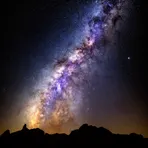
- The disk of our Milky Way Galaxy stretches directly overhead, arching its cloudy band of stars from the southeast to northwest horizons.
- stars in the Milky Way Galaxy
- center of the Milky Way Galaxy
Loading YouTube…
Watch on YouTubeAnd our sun is here, right at the edge of this Milky Way Galaxy.
- And our sun is here, right at the edge of this Milky Way Galaxy.
- Some people estimate millions, even billions just in our own Milky Way Galaxy.
- The dark matter in our own Milky Way Galaxy is just passing through US right now.
- But, you know, we we may well be the only ones in our Milky Way Galaxy.
- This is Earth coming into alignment with the plane of our solar system and our sun forming a cross with the center of our Milky Way Galaxy.
- And they provided conclusive evidence that there is a black hole at the centre of the Milky Way Galaxy that weighs about four million times the mass of the sun.
- Yeah, the the time to cross the age of the Milky Way Galaxy would be longer than the age of the universe.
- We will be surrounded by our own Milky Way Galaxy, and beyond that, there will be darkness, emptiness.
Examples
-
And so wherever we look in our Milky Way Galaxy, we tend to see these huge regions of gas clouds that are going to form new stars.
-
And in fact, if you look in our Milky Way Galaxy with telescopes, you see big clouds of gas and dust.
-
But now we know that in the Milky Way Galaxy there are more planets than there are stars.
-
And this is an image up here of how we would see the disk of the Milky Way Galaxy in the night sky.
-
On this entire picture, I believe there are three stars from our own Milky Way Galaxy, and everything else is an external Galaxy.
-
We will be surrounded by our own Milky Way Galaxy, and beyond that, there will be darkness, emptiness.
-
We now know that the Milky Way Galaxy is about 70,000 light-years in diameter.
Academic text (1991) -
And they provided conclusive evidence that there is a black hole at the centre of the Milky Way Galaxy that weighs about four million times the mass of the sun.
-
The Milky Way Galaxy is home to our solar system, which is located in one of its spiral arms.
-
Astronomers study the stars and planets within the Milky Way Galaxy to learn more about the universe.
Synonyms
 52
3.7
52
3.7
A group of stars that contains our solar system and looks like a band of light in the night sky
Surface Forms
Morphology
The name is directly compositional: 'milky' describes the pale, milk-like appearance, 'way' conveys a band or path across the sky, and 'galaxy' denotes a star system, so together they denote a galaxy that appears as a milky band. This naming logic is cross-linguistically common (e.g., Spanish 'Vía Láctea'), so a B1 learner who knows the constituent words can readily infer the meaning.
Etymology
Milky Way Galaxy may come from the old image of a faint white band of stars across the night sky that looked like a river of milk. People long ago called that bright stripe the 'milky way', and that picture is why the whole galaxy has this name today.