
Middle Ages
 45
4.1
45
4.1

- noun
- /ˈmɪdəl ˈeɪdʒɪz/
- Life made more sense in the Middle Ages when no one lasted past forty.
- the late Middle Ages
- the early Middle Ages
- the high Middle Ages
Loading YouTube…
Watch on YouTubeThat is the central period of the Middle Ages.
- That is the central period of the Middle Ages.
- The model that the Romans used, the post Roman period, we call them Middle Ages.
- And it's one of the hardest books I've read, but it's a history of why Western religion died since the Middle Ages.
- In fact, All Saints worth anything in the early Middle Ages are very touchy.
- Blood libel, the classic blood libel, the Middle Ages played out on these pages.
Examples
-
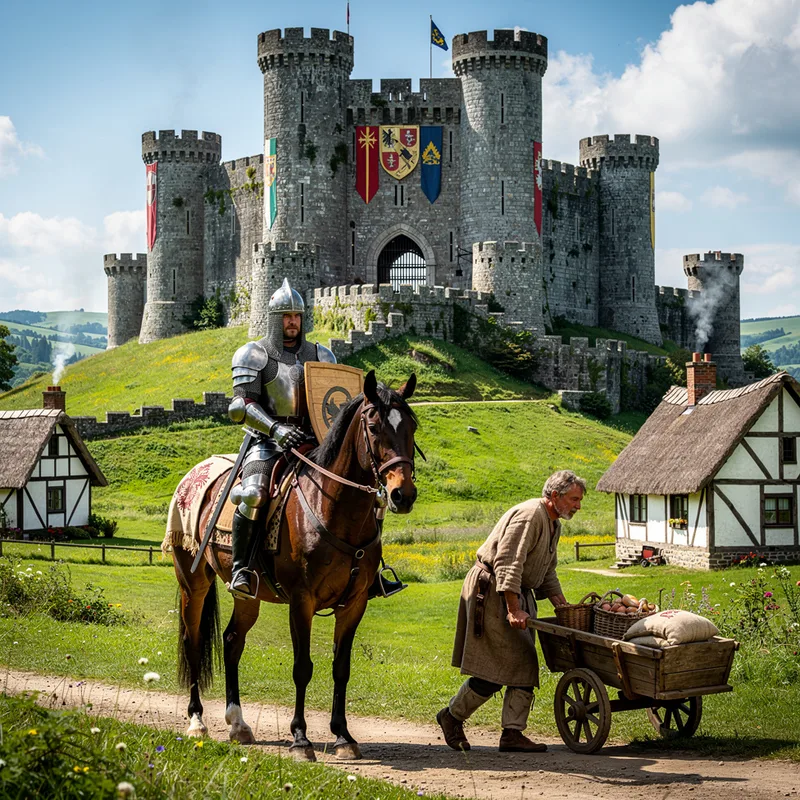
The architecture of castles from the Middle Ages showcases the power of feudal lords.
-
In Europe's Middle Ages, castles dominated not just warfare but society itself.
-
And then you see in the High Middle Ages what that means.
-
We have thousands of letters from the the high Middle Ages, which this is the the beginning.
-
Is this from the Middle Ages?
-
Story comes from the Middle Ages.
-
And what about all the people he sent there in the Middle Ages?
-
Again, some of these stem back all the way to the early Middle Ages after the fall of the Western Roman Empire.
-
We have what is known as a feudal system, like in the Middle Ages.
-
Buildings that date back to the Middle Ages stand toe-to-toe with glass skyscrapers.
Fiction book (1998)
How Old

Surface Forms
Morphology
The term is directly compositional: 'middle' (between) + 'ages' (historical periods) yields an intermediate historical period. This interpretation is cross-linguistically common (e.g., Spanish Edad Media, French Moyen Âge), so a B1 learner who knows the constituents can infer the general meaning even if they lack precise dates.
Etymology
Middle Ages: The name Middle Ages comes from later writers who saw this time as the middle period between the old world of the Greeks and Romans and the newer 'modern' world. So the phrase now means the long historical period from about the 5th to the 15th century.