

ancient history
 3
3.7
3
3.7

- noun
- /ˈeɪnʃənt ˈhɪstəri/
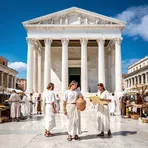
- Documentaries about ancient history provide insights into daily life and cultures from thousands of years ago.
Loading YouTube…
Watch on YouTubeBut in Russia that was Bogotheti were kind of like the Knights or maybe the Vikings, the warriors of ancient history.
- But in Russia that was Bogotheti were kind of like the Knights or maybe the Vikings, the warriors of ancient history.
- So Chera, she, she draws a lot on ancient history.
Examples
-
Are you studying ancient history now?
Fiction book (1995) -
In human terms, ancient history goes back several times as far as modern history.
Fiction book (1991) -
In few places in the world is ancient history given such immediacy as in the Middle East.
Academic text (2002) -
Would other states be interested in ancient history or in an eleventh-grade U.S. history course devoted to the modern age?
Academic text (1991) -
Another advantage is that students might once again study ancient history, which has all but disappeared from the curricula of American schools.
Academic text (1990) -
She was the most notorious woman in ancient history, a queen who enraptured not one but two of Rome's greatest generals.
-
Throughout ancient history, governments communicated by promulgating their laws and edicts on slabs of stone and bronze.
Academic text (1990) -
The museum's new exhibit explores the fascinating details of ancient history through artifacts and interactive displays.
-
Students in the class discussed significant events in ancient history, such as the rise and fall of the Roman Empire.
Synonyms
 18
7.6
18
7.6
A period before the Middle Ages, for example ancient Greece and Rome
How Old

Surface Forms
Morphology
The components 'ancient' (very old) and 'history' (the past) together signal that something belongs to the distant past, so a learner who knows both words can often infer that it refers to something old or no longer current. However, the conversational sense 'it's no longer important / it's finished' is a pragmatic extension beyond the literal combination and may not be fully predictable without exposure, so the expression is only partially transparent.
Etymology
Ancient history simply joins ancient ('very old') and history ('stories of the past'). People used it to talk about the lives and events of very old societies like Egypt and Rome, so it means 'the history of the ancient world'.