

ancient history
 7
4.6
7
4.6

- noun
- /ˈeɪnʃənt ˈhɪstəri/
- Students enrolled in the course must complete a project on a topic from ancient history.
- ancient history and mythology
- professor of ancient history
- talking about ancient history
Loading YouTube…
Watch on YouTubeActor network theory has left its mark on fields ranging from ancient history to public health.
- Actor network theory has left its mark on fields ranging from ancient history to public health.
- And when I go, when they gave examples from ancient history.
Examples
-
Many civilizations from ancient history have greatly influenced modern society.
-
Tonight is the weekly lecture on ancient history.
-
Egyptians do not know their own ancient history.
Academic text (2006) -
WHAT WE KNOW OF Beirut's ancient history is more a series of snapshots than a continuous record.
Academic text (2011) -
El Salvador's ancient history was marked by a series of volcanic eruptions.
Academic text (2009) -
With a mix of enthusiasm, diplomacy, and dogged determination, the Weigands have helped rewrite the ancient history of West Mexico.
Academic text (2006) -
The professor will give a fascinating analysis of ancient history during tonight's lecture.
Synonyms
 18
7.6
18
7.6
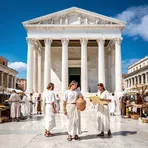
A period before the Middle Ages, for example ancient Greece and Rome
How Old

Surface Forms
Morphology
The components 'ancient' (very old) and 'history' (the past) together signal that something belongs to the distant past, so a learner who knows both words can often infer that it refers to something old or no longer current. However, the conversational sense 'it's no longer important / it's finished' is a pragmatic extension beyond the literal combination and may not be fully predictable without exposure, so the expression is only partially transparent.
Etymology
Ancient history was used by teachers and students to name the study of people and events from long ago. Museums and courses used the phrase for Greek, Roman and Egyptian times, so it means 'the study of the distant past'.