
Micrococcus


 1
8.8
- noun
- /ˌmaɪkroʊˈkɒkəs/
- Specialized
- Researchers identified a strain of Micrococcus present in the dust samples collected from the old building.
- Micrococcus melitensis
Examples
-
The scientist found Micrococcus bacteria in the soil during her research.
-
These colonies were identified as coagulase-negative staphylococci, streptococci, and Micrococcus species.
Academic text (2009) -
This test was used to differentiate between Staphylococcus and Micrococcus.
Academic text (1993) -
Shaw, on re-examining his goats, found the micrococcus in their milk and blood.
Academic text (2000) -
Bacillus and Micrococcus were the most predominant bacteria either before or after the occupancy of the plant.
Academic text (1993) -
Staphylococcus provided a positive test (a yellow tube indicates fermentation) and Micrococcus gave a negative test (no color change indicates lack of fermentation).
Academic text (1993) -
How individual enzymes of mesophilic bacteria E. coli and Micrococcus luteus react to pressure is also under evaluation.
Academic text (1994) -
Further work by Horrocks and Kennedy showed that about 50% of goats from various herds had blood agglutinins for the micrococcus, and that 10% were excreting the organism in their milk.
Academic text (2000) -
Micrococcus luteus was used as a surrogate for Gram-positive cocci because M. luteus is similar in size, shape, and cell wall composition to staphylococci, streptococci, and enterococci.
Academic text (2003) -
Micrococcus can also be found on human skin, where it usually poses no harm.
Surface Forms
Morphology
Etymology
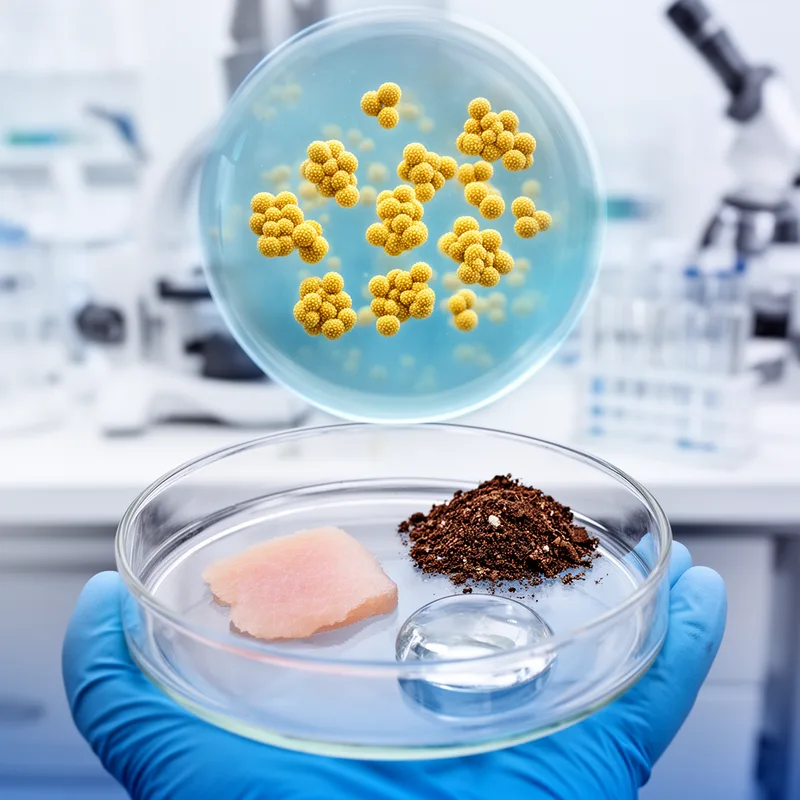
Micrococcus comes from Greek parts: micro- meaning 'small' and -coccus from a word for 'berry', so the name shows a tiny, round 'berry'. That's why Micrococcus is used for small, round bacteria often found on skin, in soil, and in water.