

Mesembryanthemum edule
- noun
- Specialized
 :
Mesembryanthemum edule
:
Mesembryanthemum edule
- Local markets often sell the tangy fruit of Mesembryanthemum edule as a regional delicacy.
Examples
-
Hikers are advised not to eat unknown plants, but Mesembryanthemum edule is known to be safe and edible.
-
The sandy dunes were covered in Mesembryanthemum edule, adding a splash of green and purple to the landscape.
-
The Mesembryanthemum edule thrives in sandy soils.
-
Farmers in South Africa cultivate Mesembryanthemum edule for its fruit.
-
Local markets often sell the tangy fruit of Mesembryanthemum edule as a regional delicacy.
-
Hikers are advised not to eat unknown plants, but Mesembryanthemum edule is known to be safe and edible.
-
Farmers in South Africa cultivate Mesembryanthemum edule for its nutritious fruit.
Synonyms

A low plant from South Africa with thick leaves that makes small edible fruit

A low plant with thick, fleshy leaves and sweet edible fruit from South Africa
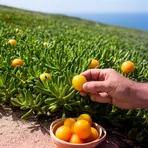
A low plant with thick leaves used as ground cover that has edible fruit

A low plant with thick leaves that grows on coastal sand and has edible fruit
Surface Forms
Morphology
Mesembryanthemum + edule
This is a taxonomic binomial combining the genus name 'Mesembryanthemum' with the epithet 'edule' (from Latin meaning 'edible'), so the overall meaning — an edible Mesembryanthemum succulent — is directly derivable from the constituents. Although 'edule' is a Latin form that many B1 learners may not know, given knowledge of both parts the composition is straightforward and not idiomatic.
Etymology
Mesembryanthemum edule may come from old Greek and Latin words. The part Mesembryanthemum means 'midday flower' because these plants often open their flowers around noon, and edule means 'edible', which points to the plant's tasty fruit, so the name tells us it is a 'midday flower' with edible fruit.

