
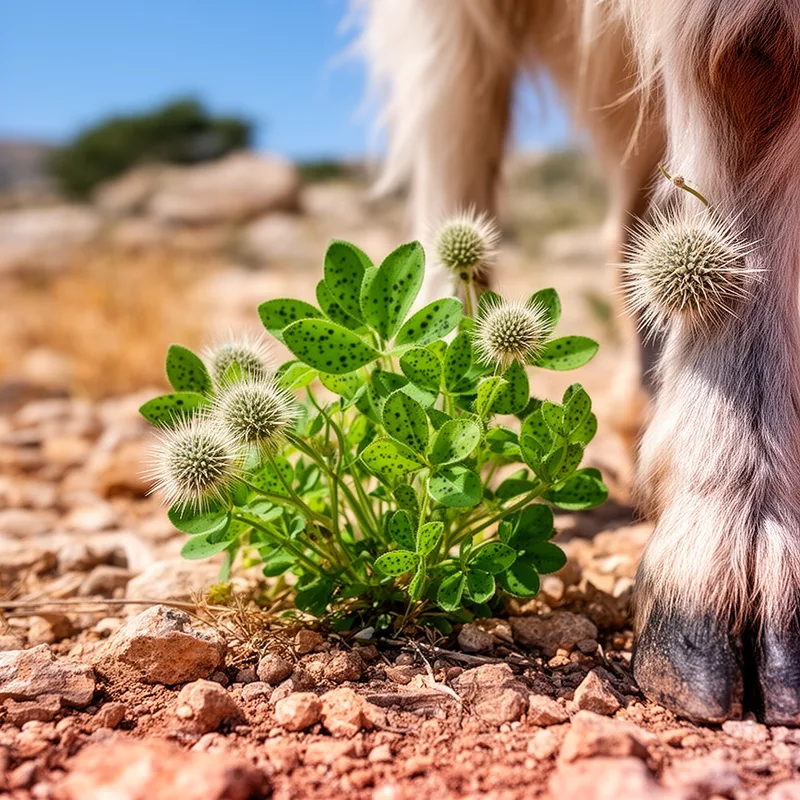
Medicago echinus
- noun
- Specialized
- The spiny seed pods of Medicago echinus can easily attach to animal fur.
Examples
-
Medicago echinus thrives in dry, rocky soils throughout the Mediterranean region.
-
Botanists recorded the flowering period of Medicago echinus during their spring survey.
-
The Medicago echinus thrives in dry Mediterranean climates.
-
Is Medicago echinus easy to grow in a garden?
-
Medicago echinus is known for its distinctive spiny seed pods that can irritate skin upon contact.
-
Medicago echinus often blooms in the spring, attracting various pollinators to its bright flowers.
-
Gardeners appreciate Medicago echinus for its ability to flourish in poor soil conditions typical of the Mediterranean.
Synonyms
A small annual plant from the Mediterranean with spiny seed pods and spotted clover-like leaves
A plant that lives for one year with spiny seed pods and dark spots on its leaves
Surface Forms
Morphology
Medicago + echinus
This is a scientific Latin binomial (genus + species) where the species epithet 'echinus' is not given as an English lexical item; understanding the descriptive meaning requires specialist botanical or Latin-root knowledge. A B1 learner who knows 'Medicago' but not the Latin/technical sense of 'echinus' (or taxonomic naming conventions) would not be able to derive the plant's descriptive properties, so the expression is not transparently interpretable.
Etymology
Medicago echinus may come from two old words: Medicago for plants from the Mediterranean area and echinus meaning 'hedgehog' or 'sea urchin'. The second word paints the picture of the plant's round, spiny seed pods that stick to fur, so the name points to a spiny Mediterranean plant.

