
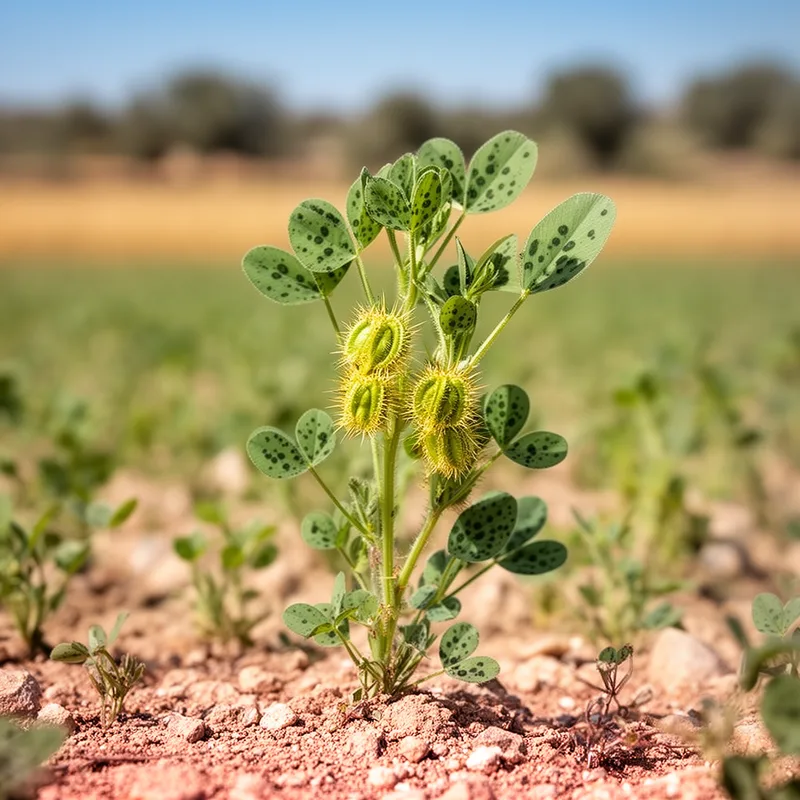
Medicago intertexta
- noun
- Specialized
- The leaves of Medicago intertexta are distinctive, featuring dark spots and spiny seed pods.
Examples
-
The leaves of Medicago intertexta are distinctive, featuring dark spots and a clover-like appearance.
-
Farmers sometimes use Medicago intertexta as a cover crop to enrich the soil with nitrogen.
-
Medicago intertexta thrives in sunny, well-drained soils of the Mediterranean region.
-
The Medicago intertexta thrives in dry Mediterranean climates.
-
Did you see the Medicago intertexta growing in the garden?
-
Farmers sometimes use Medicago intertexta as a cover crop to improve soil health.
-
In spring, Medicago intertexta blooms beautifully in Mediterranean gardens.
Synonyms

An annual plant native to the Mediterranean with spiny seed pods and leaves with dark spots
A plant that lives for one year with spiny seed pods and dark spots on its leaves
Surface Forms
Morphology
Medicago + intertexta
The phrase is a Latin binomial (genus + specific epithet), so a learner who knows 'Medicago' can transparently infer this refers to a species within that genus. However, the second element 'intertexta' is Latin/unattested in English and does not convey the plant's specific properties (spiny seed pods, spotted leaves), so the full descriptive meaning is not predictable from the parts.
Etymology
Medicago intertexta comes from old words: Medicago may mean plants 'from Media', an old region, and intertexta means 'woven between'. Think of a small Mediterranean plant with dark spots on its leaves and seed pods that look twisted or 'woven' between the leaf parts, and that picture helps explain the name and make the plant easier to remember.

