
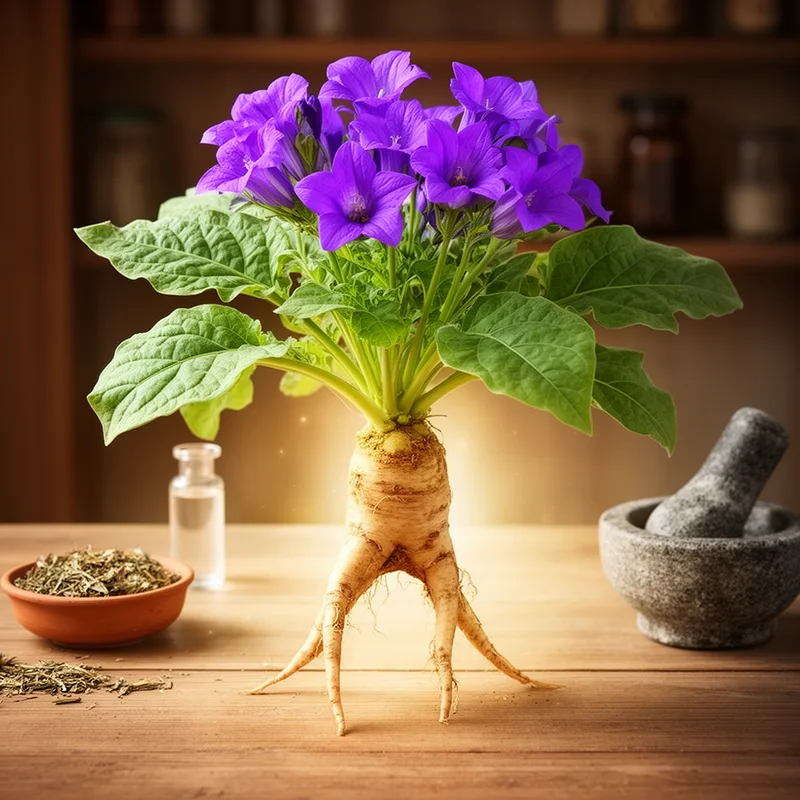
Mandragora officinarum
- noun
- Specialized
 :
mandrágora officinarum
:
mandrágora officinarum
- The forked root of Mandragora officinarum often resembles a human figure, leading to many legends.
Examples
-
Researchers studied the medicinal properties attributed to Mandragora officinarum in traditional herbal remedies.
-
In ancient times, Mandragora officinarum was thought to have mystical powers and was used in various rituals.
-
The Mandragora officinarum plant has been used in traditional medicine.
-
Many herbalists believe that Mandragora officinarum has magical properties.
-
In ancient times, Mandragora officinarum was thought to have mystical powers and was used in various rituals.
-
Researchers studied the medicinal properties attributed to Mandragora officinarum in traditional herbal remedies.
-
The forked root of Mandragora officinarum often resembles a human figure, leading to many legends.
Synonyms

 1
9.9
1
9.9

A plant with purple or white flowers and a forked root believed to have magical powers

A Mediterranean plant with purple flowers, yellow fruit, and a forked root that people once thought had magic
Surface Forms
Morphology
Mandragora + officinarum
This is a Latin scientific binomial functioning as a proper name rather than a compositional English phrase; one constituent ('officinarum') is not a standard English word and is not listed in the provided definitions. Even if a learner knew that 'Mandragora' is a plant, the full specific sense (a particular perennial species with historical medicinal/magical associations) and the Latin morphological form are not predictably derivable, so the expression is not transparently interpretable by a B1 learner.
Etymology
Mandragora officinarum has a forked root that often looks like a small human, so people long ago told a strong story about it. One popular story says that pulling the forked root made a loud scream, so people believed the plant had special powers and used it in 'magic' and 'medicine'. That's why the plant is still known today for its strange, powerful reputation.