

Madame Curie
- proper noun
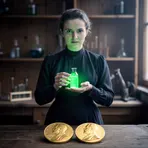
- Madame Curie was the first woman to win a Nobel Prize.
Examples
-
The work of Madame Curie revolutionized our understanding of radioactivity.
-
Many universities have buildings named after Madame Curie to honor her achievements.
-
Madame Curie was the first woman to win a Nobel Prize in any field.
-
Did Madame Curie really discover radium?
-
Madame Curie made groundbreaking contributions to the study of radioactivity.
-
In her lifetime, Madame Curie became an inspiration for women in science.
-
The achievements of Madame Curie continue to influence research in chemistry and physics.
Synonyms
 3
5.8
3
5.8

A French scientist born in Poland who discovered radium and won two Nobel Prizes

Polish-born French chemist and physicist who won two Nobel Prizes for work on radioactivity and discovering radium and polonium

The birth name of Marie Curie, a Polish scientist who studied radioactivity
Surface Forms
Morphology
This is a proper name built from the French honorific 'madame' and the surname 'Curie', so a learner who knows the constituents will understand it refers to a woman called Curie (and likely a French/formal reference). However, the specific factual information about her being a famous chemist/physicist and two-time Nobel laureate is encyclopedic and cannot be derived from the words alone, giving only partial inferability.
Etymology
Madame Curie comes from Maria Skłodowska-Curie, a Polish-born scientist who moved to France and worked on radioactivity. She was called Madame as a polite title and Curie was her family name, and because she discovered new elements like radium and polonium and won two Nobel Prizes, the name now refers to that famous scientist.