

Marie Curie
- proper noun
- Marie Curie was the first person to win Nobel Prizes in two different sciences.
Examples
-
The contributions of Marie Curie to the field of radioactivity changed modern science.
-
Many young scientists are inspired by the achievements of Marie Curie.
-
Did you know that Marie Curie was the first woman to win a Nobel Prize?
-
Marie Curie discovered radium and polonium.
-
Marie Curie was the first woman to win a Nobel Prize for her research on radioactivity.
-
In 1903, Marie Curie shared the Nobel Prize in Physics with her husband Pierre and Henri Becquerel.
-
Marie Curie's groundbreaking discoveries led to the development of X-ray machines using radioactivity.
Synonyms
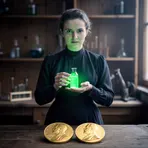
 3
5.8
3
5.8

A French scientist born in Poland who discovered radium and won two Nobel Prizes
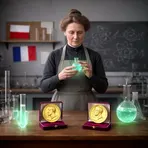
A scientist born in Poland who worked in France and won two Nobel Prizes for discovering radium and polonium

The birth name of Marie Curie, a Polish scientist who studied radioactivity
Surface Forms
Morphology
Marie + Curie
This is a proper name referring to a specific historical person; knowing the parts 'Marie' and 'Curie' does not allow a learner to infer the biographical meaning (Polish‑born French chemist, Nobel laureate). Proper names are referential/arbitrary rather than compositional, so the MWE's information about profession and achievements is not derivable from its constituents.
Etymology
Marie Curie was a Polish-born scientist who worked with glowing minerals that gave off energy called 'radioactivity'. She discovered radium and polonium and won two Nobel Prizes, so her name stands for very important work in science.