
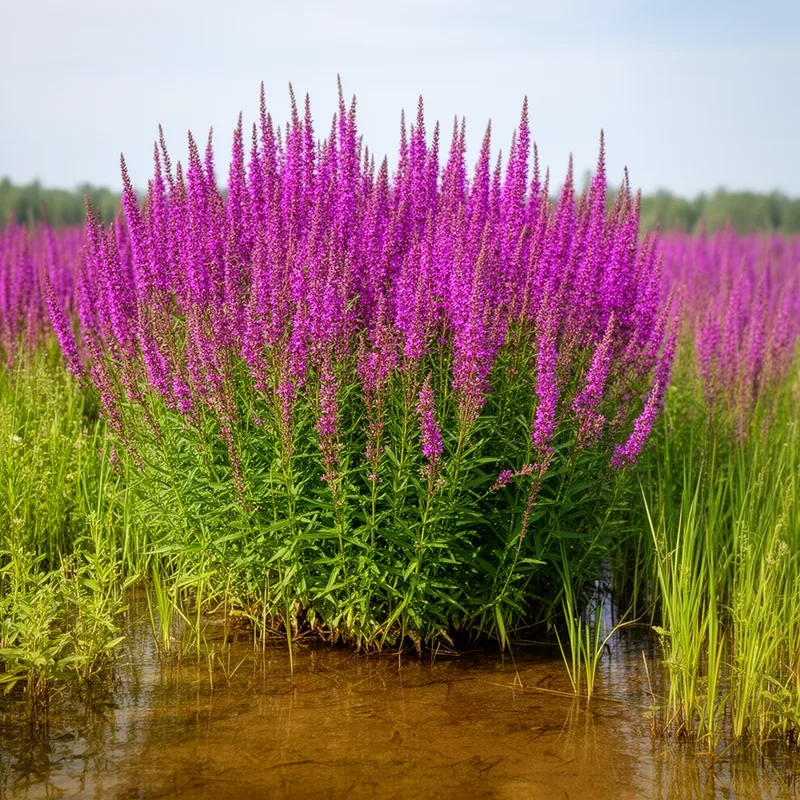
Lythrum salicaria
- noun
- Specialized
- The wetland was invaded by Lythrum salicaria, threatening native plant species.
Examples
-
Researchers studied how Lythrum salicaria affects the ecosystem of the marsh.
-
The Lythrum salicaria blooms in late summer.
-
Gardeners were warned not to plant Lythrum salicaria due to its invasiveness.
-
Look at that stunning Lythrum salicaria in the garden!
-
Gardeners were warned not to plant Lythrum salicaria due to its invasiveness.
-
The wetland was invaded by Lythrum salicaria, threatening native plant species.
-
Researchers studied how Lythrum salicaria affects the ecosystem of the marsh.
Synonyms


 1
8.9
1
8.9
A tall marsh plant with long purple flower spikes that crowd out native plants
A marsh plant with tall spikes of purple flowers
Surface Forms
Morphology
Lythrum + salicaria
This is a Latin binomial (genus + species) rather than a regular English phrase; the components are botanical Latin, not productive English words. A B1 learner knowing the brief gloss for 'Lythrum' might guess it is a plant, but the specific epithet 'salicaria' is not an English word and offers no predictable English-based meaning. Scientific names are not compositionally interpretable by average learners, so the overall meaning cannot be derived from the parts.
Etymology
Lythrum salicaria comes from old Greek and Latin words: Lythrum from a Greek word meaning 'blood' for its deep red‑purple flowers, and salicaria from Latin meaning 'like a willow' because its leaves look like willow leaves. So the name describes the plant's colour and leaf shape.