
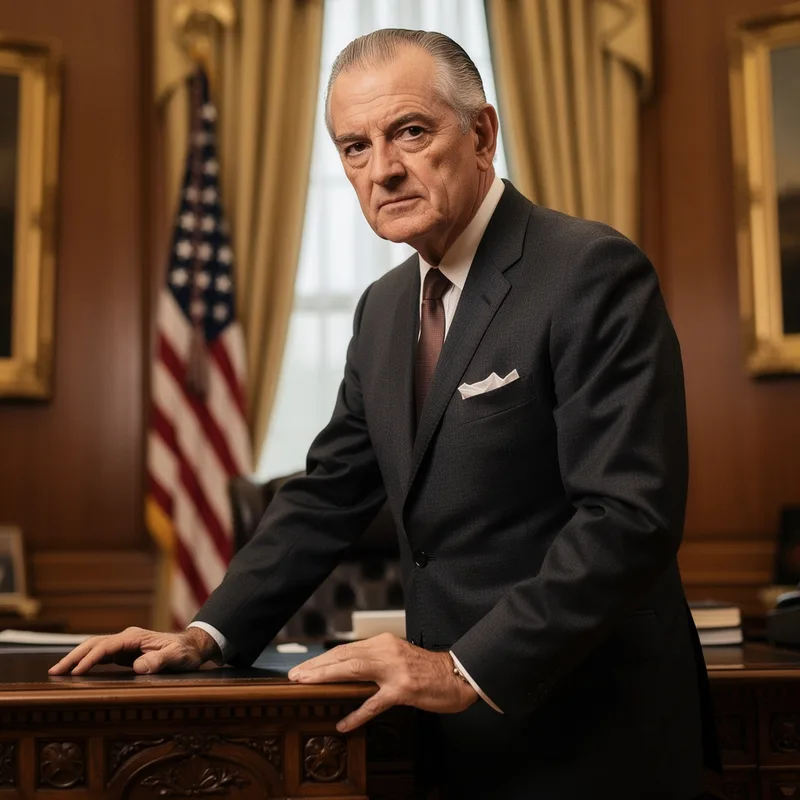
Lyndon Johnson
 81
3.5

- proper noun
- /ˈlɪndən ˈdʒɒnsən/
- Consider the foot-race analogy made by President Lyndon Johnson when he argued for affirmative action and compensatory education.
- President Lyndon Johnson
- Lyndon Johnson after Kennedy
- initiated under Lyndon Johnson
Examples
-
The "Great Society" pushed forth by Lyndon Johnson in the 60s has not worked!
Blog text (16) -
"I looked upon them as a kind of continuum of what had been initiated under Lyndon Johnson," Carter said of his civil rights policies.
Academic text (2004) -
His story is linked with Lyndon Johnson, who wanted his library to be a "tree without the bark."
Blog text (5) -
Three weeks later, President Lyndon Johnson sends 3,000 federal troops to Alabama.
Fiction book (2000) -
Lyndon Johnson was a domestic policy man, an extraordinary wheeler-dealer focused on pushing new legislation through Congress.
Academic text (2009) -
In 1964, when Higginbotham was not quite 36, President Lyndon Johnson appointed him to the U.S. District Court in Philadelphia.
Academic text (1996) -
President Lyndon Johnson, who considered the Kennedys a "little too conservative for my taste," did evoke the 1930s.
Academic text (1997) -
Truman wanted Congress to enact Medicare, but nothing happened until Lyndon Johnson got it passed in 1965.
Academic text (1992) -
Congress approved a tax code amendment by Sen. Lyndon Johnson in 1954 prohibiting tax-exempt organizations from engaging in certain forms of political activity.
Academic text (2011) -
In 1964, President Lyndon Johnson signed the Civil Rights Act, a landmark piece of legislation.
Synonyms
 33
6.2
The 36th President of the United States from 1963 to 1969
 8
4.8
The 36th President of the United States who served from 1963 to 1969
Surface Forms
Morphology
Lyndon + Johnson
This is a proper name: the lexical parts 'Lyndon' and 'Johnson' are arbitrary personal names that do not encode the information that the bearer was the 36th U.S. President. A B1 learner who only knows the constituent words would not be able to derive the biographical/political meaning from the name itself, so the expression is non-compositional for learners.
Etymology
Lyndon Johnson is the 36th President of the United States who became president after John F. Kennedy was killed. He signed the 'Civil Rights Act' in 1964 to help equal rights and he greatly increased U.S. involvement in the 'Vietnam War', so when people say Lyndon Johnson they often mean that president and his major actions.