
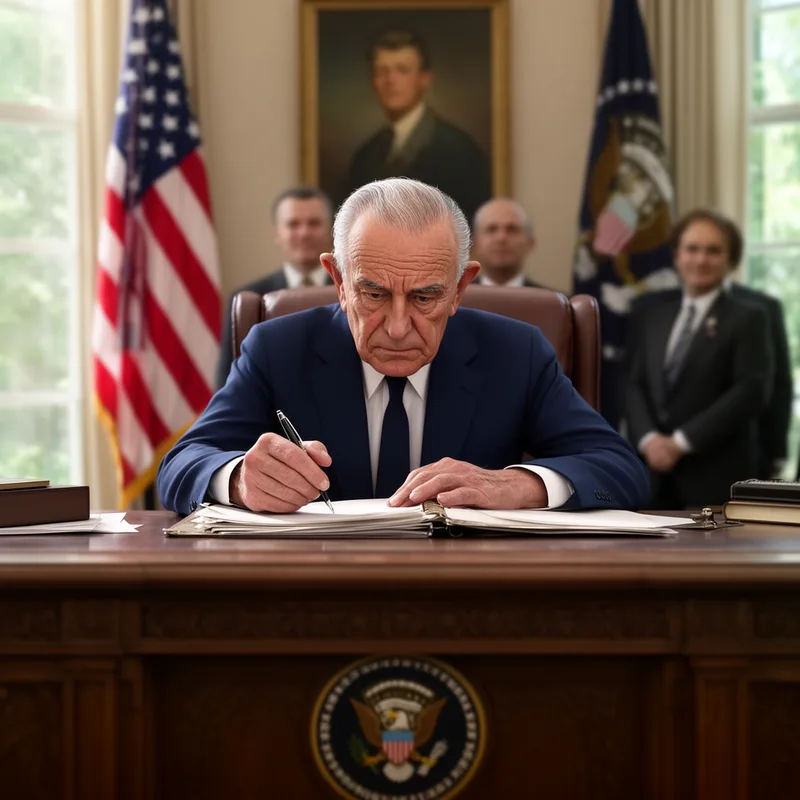
Lyndon B. Johnson
 8
4.8

- proper noun
- /ˈlɪndən bi ˈdʒɒnsən/
- During his presidency, Lyndon B. Johnson signed the Civil Rights Act into law in 1964.
- Lyndon B. Johnson
- President Lyndon B. Johnson
Examples
-
Many historians debate Lyndon B. Johnson's legacy regarding the Vietnam War.
-
Lyndon B. Johnson signed the Civil Rights Act into law in 1964.
-
Lyndon B. Johnson became president after John F. Kennedy was assassinated.
-
Lyndon B. Johnson was the 36th President of the United States.
-
The legacy of Lyndon B. Johnson includes the Great Society programs.
-
In 1963, President Lyndon B. Johnson took office following the assassination of John F. Kennedy.
-
The Great Society programs were a hallmark of President Lyndon B. Johnson's administration.
Synonyms
 81
3.5
The 36th President of the United States from 1963 to 1969 who took office after John F. Kennedy died
 33
6.2
The 36th President of the United States from 1963 to 1969
Surface Forms
Morphology
Lyndon + B. + Johnson
This is a full proper name referring to a specific historical person; the factual meaning (that he was the 36th U.S. President who served 1963–1969) cannot be derived from the constituent name-parts 'Lyndon', 'B.', and 'Johnson'. Learners who know those words only recognize a person’s name (and perhaps that it is English/Western), but will not be able to infer the referential, historical information, so the expression is non-compositional for B1 learners.
Etymology
Lyndon B. Johnson was the 36th President of the United States and is often called 'LBJ' from his initials. He became president after John F. Kennedy was shot in 1963 and signed big laws like the 'Civil Rights Act', so his name usually brings to mind that leader and those changes.