
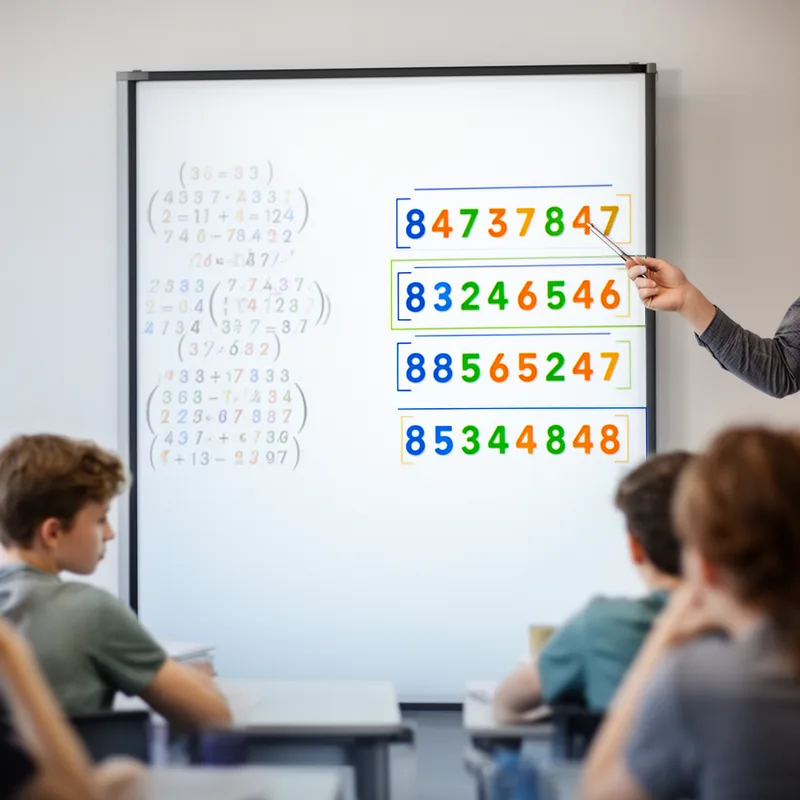
Lukasiewicz notation
- noun
- /ˌluːkəˈsɛvɪtʃ noʊˈteɪʃən/
- Specialized
 :
notación de Lukasiewicz
:
notación de Lukasiewicz
- In Lukasiewicz notation, the operator always precedes the operands, making it a unique way to structure equations.
Examples
-
Understanding Lukasiewicz notation allows you to write mathematical expressions without using any parentheses.
-
The programming language was designed around Lukasiewicz notation to simplify parsing mathematical expressions.
-
Learning Lukasiewicz notation can help students understand the structure of complex formulas.
-
Many calculators use Lukasiewicz notation to allow for easier computation without parentheses.
-
The formula is expressed using Lukasiewicz notation.
-
Can you explain Lukasiewicz notation to me?
-
Many programming languages implement Lukasiewicz notation for more efficient computation of algebraic expressions.
Synonyms

A way of writing math expressions where the operator comes before the numbers so no parentheses are needed

A way of writing math expressions without parentheses where a math sign like + or − comes before the numbers
A way of writing math expressions that uses the order of math signs instead of extra marks
Surface Forms
Morphology
Lukasiewicz + notation
This is an eponymic technical term: 'Lukasiewicz' is a proper name with no inherent meaning for learners, and 'notation' only indicates a generic system of symbols. A B1 learner who knows both constituents would not be able to infer the crucial structural property (prefix, parenthesis-free operator-before-operands), so the overall meaning is not derivable from the parts.
Etymology
Lukasiewicz notation is named after Jan Łukasiewicz, who invented a way to write math with the action first: the operator, the action, comes before the operands, the numbers, so you might write 'add 2 3' instead of '2 plus 3'. That's why this system is called 'prefix notation' and lets you write expressions 'without parentheses'.

