
Lepiota rhacodes
- noun
- Specialized
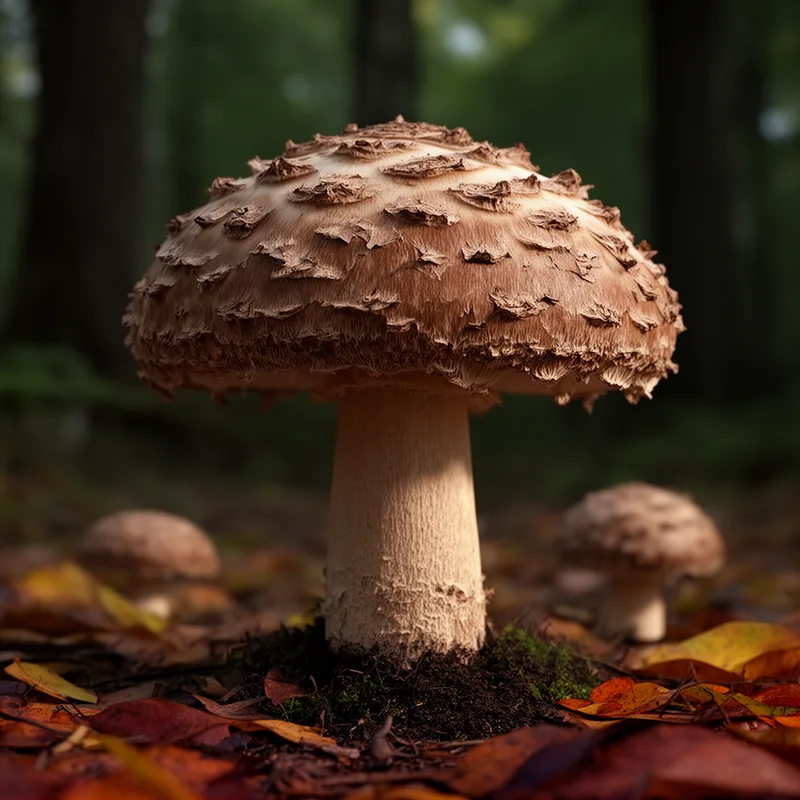
- The Lepiota rhacodes, commonly known as the shaggy parasol, is easy to identify by its large brown cap and thick stalk.
Examples
-
The Lepiota rhacodes grows in shaded woodland areas during late summer and autumn.
-
We found a cluster of Lepiota rhacodes while foraging in the forest.
-
Care should be taken, as some people may have allergic reactions to the Lepiota rhacodes.
-
The Lepiota rhacodes has a distinct brown cap.
-
Have you ever seen a Lepiota rhacodes in the wild?
-
While hiking in the woods, we spotted several Lepiota rhacodes among the fallen leaves.
-
Many mycologists recommend studying the Lepiota rhacodes due to its unique features and habitat preferences.
Surface Forms
Morphology
lepiota + rhacodes
This is a Latin binomial: 'Lepiota' names a genus of fungi, so a learner who recognizes that component can infer it denotes a type of mushroom, but 'rhacodes' is not a common English word (dictionary entry missing) and does not transparently convey the species' specific features. Because the genus component gives a partial, predictable cue (a kind of fungus) but the full descriptive meaning (shaggy parasol, brown-capped) cannot be derived from the parts, the expression is only partially transparent.
Etymology
Lepiota rhacodes may come from old Greek words: Lepiota meaning 'scale' and rhacodes meaning 'ragged', because the mushroom has a scaly, shaggy cap and a thick stalk. That's why people call it the 'shaggy parasol' and why the name describes how it looks.

