

Klinefelter's syndrome
- noun
- /ˈklaɪnəˌfɛltərz ˈsɪnˌdroʊm/
- Specialized
- Men with Klinefelter's syndrome may have difficulty with fertility due to reduced sperm production.
Examples
-
Early identification of Klinefelter's syndrome can help manage symptoms and improve quality of life.
-
Many individuals with Klinefelter's syndrome experience reduced fertility.
-
Doctors diagnosed the teenager with Klinefelter's syndrome after noticing unusual physical development.
-
He was diagnosed with Klinefelter's syndrome at the age of 20.
-
Doctors diagnosed the teenager with Klinefelter's syndrome after noticing unusual physical development.
-
Early identification of Klinefelter's syndrome can help manage symptoms and improve quality of life.
-
Men with Klinefelter's syndrome may have difficulty with fertility due to reduced sperm production.
Synonyms

 1
6.7
1
6.7

A change in the number or shape of chromosomes that often causes health problems

 1
9.9
1
9.9
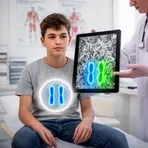
A male with two X chromosomes and one Y chromosome

A genetic condition in males with an extra X chromosome causing small testes, low sperm, and learning problems

A male condition caused by an extra X chromosome that often causes small testes and reduced fertility
Surface Forms
Morphology
Klinefelter's + syndrome
This is an eponymous medical term: the element 'syndrome' clearly signals a set of symptoms/a medical disorder, so a learner who knows 'syndrome' can infer it denotes a health condition named after someone. However, the specific genetic meaning (an extra X chromosome in males and the particular symptoms listed) is not derivable from 'Klinefelter's' or 'syndrome' alone, so detailed interpretation requires prior exposure or explanation.
Etymology
Klinefelter's syndrome is named after Dr. Harry Klinefelter, the doctor who first described this set of physical and learning features in men. He noticed men with an extra X chromosome, written as 'XXY', so the name now stands for that genetic condition.