

Klinefelter syndrome
- noun
- /ˈklaɪnˌfɛltər ˈsɪnˌdroʊm/
- Specialized
- Babies born with Klinefelter syndrome (47, XXY) have normal male genitalia.
- men with Klinefelter syndrome
Examples
-
Most men with Klinefelter syndrome are infertile, but an unknown proportion are fertile (Warburg, 1963).
Academic text (2002) -
Males with Klinefelter syndrome often experience delayed puberty due to their condition.
-
Klinefelter syndrome.
Academic text (2002) -
Because Klinefelter syndrome is most often discovered in the course of infertility evaluation, fertile men with Klinefelter syndrome are likely to go completely undetected.
Academic text (2002) -
Because Klinefelter syndrome is most often discovered in the course of infertility evaluation, fertile men with Klinefelter syndrome are likely to go completely undetected.
Academic text (2002) -
Specifically, Fausto-Sterling includes Klinefelter syndrome, Turner syndrome, and all other non-XX, non-XY chromosomal variations in the intersex category.
Academic text (2002) -
Abramsky and Chapple (1997) have suggested that many men with Klinefelter syndrome are never diagnosed because they are phenotypically indistinguishable from normal (46, XY) men.
Academic text (2002) -
Many reviewers are not aware that this figure includes conditions that most clinicians do not recognize as intersex, such as Klinefelter syndrome, Turner syndrome, and late-onset adrenal hyperplasia.
Academic text (2002) -
Doctors may recommend hormone therapy for men diagnosed with Klinefelter syndrome to help with physical development.
-
In some cases, individuals with Klinefelter syndrome may face challenges in learning, impacting their educational experience.
Synonyms

 1
6.1
1
6.1

A change in the number or shape of chromosomes that often causes health problems
 1
6.7
1
6.7
A change in the number or shape of chromosomes that often causes health problems

 1
9.9
1
9.9
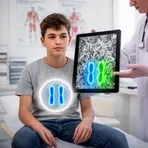
A male with two X chromosomes and one Y chromosome

A condition in males when they have an extra X chromosome that makes the testicles small and reduces sperm

A male condition caused by an extra X chromosome that often causes small testes and reduced fertility
Surface Forms
Morphology
Klinefelter + syndrome
The headword 'syndrome' clearly signals a medical condition or set of symptoms, so a learner who knows that word can infer this is a disorder. However, 'Klinefelter' is an eponymous proper name with no lexical meaning that would indicate the genetic cause or specific features, so the full, specific meaning is not derivable from the parts. This yields partial but not complete transparency.
Etymology
Klinefelter syndrome was named after Dr. Klinefelter, who first noticed men with an 'extra X chromosome'. The word syndrome means a 'set of symptoms', so the name today points to that specific condition and its common signs.