

Kelvin scale
- noun
- /ˈkɛlvɪn skeɪl/
- Specialized
- In physics, temperatures are often expressed in the Kelvin scale for clarity and precision.
Examples
-
Physicists prefer to use the Kelvin scale when discussing thermodynamic laws.
-
Temperatures on the Kelvin scale start at absolute zero, the theoretical point where all motion stops.
-
When reporting their results, the researchers converted Celsius readings to the Kelvin scale.
-
The Kelvin scale is essential in physics.
-
What is the freezing point on the Kelvin scale?
-
The Kelvin scale is essential for scientists to accurately report extreme temperatures.
-
Water boils at 373.15 on the Kelvin scale, which is equivalent to 100 degrees Celsius.
Synonyms
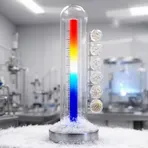
A temperature scale that starts at absolute zero, with zero as the lowest possible temperature
Surface Forms
Morphology
The phrase is compositionally built from the unit name 'kelvin' and the noun 'scale' (a system of measurement), so a learner who knows both words can infer it refers to a temperature-measurement system using kelvins. While finer scientific details (e.g., absolute zero or relation to Celsius) require domain knowledge, the core meaning is directly derivable from the constituents.
Etymology
The Kelvin scale is named after a scientist called Lord Kelvin and measures temperature from 'absolute zero', the coldest point where all motion stops. Its units, called kelvins, are the same size as degrees Celsius, so scientists use this scale when they want a clear zero point for measurements.

