

Japanese pagoda tree
- noun
- They admired the shade provided by the old Japanese pagoda tree in the garden.
Examples
-
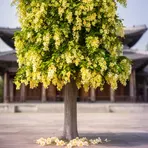
In late summer, the Japanese pagoda tree produces showy clusters of creamy-white flowers.
-
The Japanese pagoda tree is often planted in parks for its attractive foliage and blossoms.
-
The Japanese pagoda tree is beautiful in spring.
-
Many Japanese pagoda trees bloom in the park.
-
The Japanese pagoda tree in the park is famous for its beautiful clusters of creamy-white flowers.
-
Many people gather under the large canopy of the Japanese pagoda tree to enjoy its cool shade.
-
In spring, the Japanese pagoda tree blossoms, releasing a sweet fragrance that attracts many bees.
Synonyms


 1
9.3
1
9.3
A tall Asian tree that often grows near temples and has fragrant yellow and white flowers

A tree from China and Japan with dark green leaves and clusters of fragrant creamy-white flowers

A tree from China and Japan with a rounded top, dark green leaves, and many fragrant creamy-white flowers

A tree that loses its leaves and has dark green leaf groups and creamy-white fragrant flowers

A tree from China and Japan that loses its leaves and has dark green leaves and fragrant white flower clusters
Surface Forms
Morphology
The phrase combines transparent constituents: 'Japanese' (origin/association with Japan), 'pagoda' (a type of Asian temple or shape), and 'tree' (a plant), so a learner can infer this is a kind of tree associated with or named for pagodas in Japan. This follows common noun-noun naming patterns for plants (e.g., 'Japanese maple'), making the meaning predictable for a B1 learner who knows the parts.
Etymology
Japanese pagoda tree may get its name from the way the tree's branches and flower clusters form flat, layered shapes like the roofs of a pagoda, and people often planted it near pagodas in old gardens. That's why the name is used for this kind of tree with a rounded crown and creamy-white flowers.