

Iroquois League


 1
8.6
- proper noun
- /ˈɪrəˌkwɔɪ lɪɡ/
- After 1722, the Tuscarora joined the Iroquois League, resulting in it being called the Six Nations.
Examples
-
The Iroquois League played a crucial role in shaping the political landscape of northeastern North America.
-
Historians often discuss the structure and governance of the Iroquois League as a model of federalism.
-
The Iroquois League was a powerful confederation.
-
Did the Iroquois League influence American democracy?
-
The Iroquois League played a significant role in North American history as a confederation of tribes.
-
The members of the Iroquois League worked together to maintain peace and cooperation among their nations.
-
In the 18th century, the Iroquois League served as an influential alliance in the struggle against European colonization.
Synonyms
 4
9.9
A group of Indigenous nations in northeastern North America
 1
7.4
A group of six Native American tribes including Mohawk and Oneida
 1
8.2
A group of five Iroquois tribes in northeastern North America that make rules and fight together when needed
 1
6.4
An alliance of several tribes that join to act together
 1
8.5
A group of five Iroquois tribes in eastern North America that formed a political alliance and later added a sixth
Surface Forms
Morphology
The compound pairs the proper name 'Iroquois' (the people) with 'league' (an organized alliance), so a learner who knows both words can infer it denotes an alliance or confederation of the Iroquois. This is a straightforward, compositional noun + noun construction following common cross-linguistic patterns, making the meaning directly derivable from the constituents.
Etymology
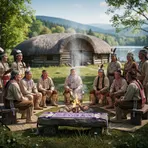
Iroquois League comes from several Native American nations joining together like a team to keep peace and make common rules. Leaders met in a longhouse and used a wampum belt, a belt of shell beads, to show they agreed, so the name means 'a group of tribes that worked together'.