

Five Nations
- proper noun
- /faɪv ˈneɪʃənz/
- Following peace treaties that the Mohawks and their confederates in the Five Nations signed with New France between 1665 and 1667, Jesuit priests set up shop in nearly every major Iroquois town.
Examples
-
To understand Smits Jan, one must consider the political history of the Five Nations, for his career chronicles some of its main features, from struggles within the league to relations with Europeans and other Indian peoples.
Academic text (2010) -
The Five Nations played a crucial role in the diplomatic politics of northeastern North America during the 17th century.
-
The western Indians appealed to the Six (formerly five) Nations to join them in their war against the Americans.
Academic text (1995) -
By 1684, the Five Nations and New France were once again poised for war against each other, and the Jesuits closed their Mohawk missions.
Academic text (1992) -
Brothers: The ancient confederacy that subsisted between us and the Five Nations was that if any of the Five Nations were in distress, we would take them to us; we now see that you are in distress; that you are surrounded by water and have no dry land to stand upon; that a large white beast stands with open mouth on the other side, ready to destroy you.
Academic text (1995) -
Brothers: The ancient confederacy that subsisted between us and the Five Nations was that if any of the Five Nations were in distress, we would take them to us; we now see that you are in distress; that you are surrounded by water and have no dry land to stand upon; that a large white beast stands with open mouth on the other side, ready to destroy you.
Academic text (1995) -
Were the Five Nations not in fact offering the Hurons an alternative solution to that of the Jesuits, one in which the Hurons would leave the alien, strife-torn world introduced by the Jesuits to come under their Great Tree of Peace?
Academic text (1992) -
As the Iroquois knew well, these adoptees were not all assimilated, and Daniel Richter has argued that the Five Nations found it increasingly difficult to integrate foreigners at this time.
Academic text (2010) -
What Finley meant by "high priest" is evidently a "Faithkeeper" of the type known to the Five Nations Iroquois, an officially designated preserver of traditional beliefs and practices.
Academic text (1992) -
The history of the Five Nations reveals much about the complex relationships between different tribes and European settlers.
Synonyms
 5
9.9
5
9.9

A group of Indigenous nations in northeastern North America

A group of five Iroquois tribes in eastern North America that formed a political alliance and later added a sixth

A group of Native American tribes in northeastern North America that joined together

An alliance of several tribes that join to act together
Surface Forms
Morphology
The components 'five' and 'nation' transparently indicate a grouping of five peoples or countries, so a learner could infer a general sense of a five-member collective. However, the fixed proper-name sense referring specifically to the historical Iroquois confederation (the Mohawk, Oneida, Onondaga, Cayuga, Seneca) is culturally specific and not predictable from the parts alone, so full understanding requires prior exposure.
Etymology
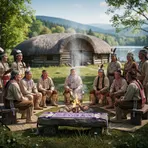
Five Nations comes from a real alliance of five Iroquois tribes; imagine five chiefs sitting around one fire to make rules and protect each other. So Five Nations means that group, or an 'alliance' of tribes.