
Inquisition
 42
9.1
42
9.1

- noun
- /ˌɪnkwɪˈzɪʃən/
- Literature
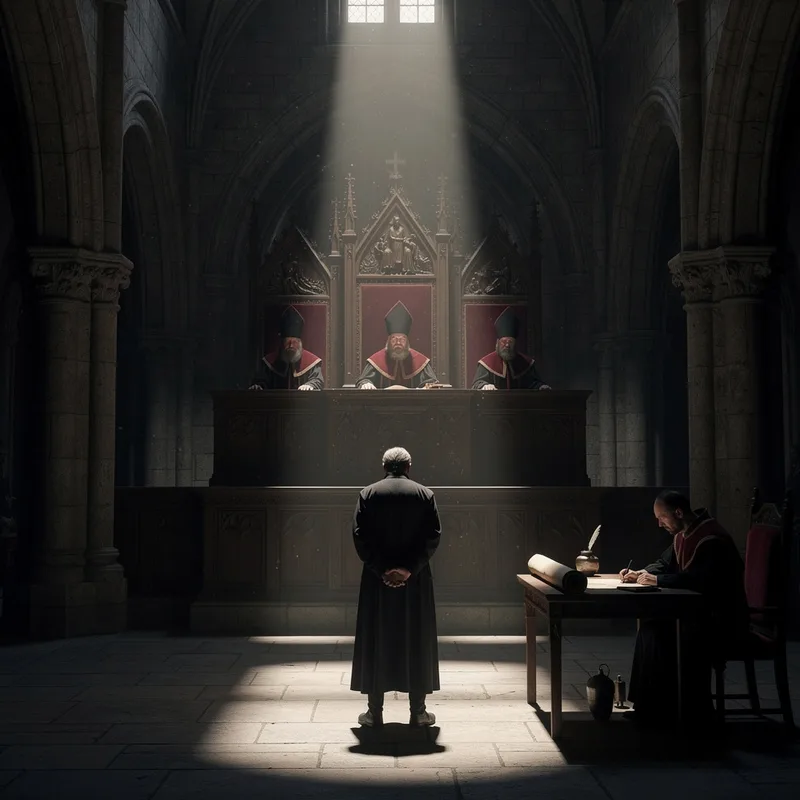
- The Inquisition was notorious for punishing those accused of heresy during the Middle Ages.
- Spanish Inquisition
- confessions of the Inquisition
- heretics of the Inquisition
Loading YouTube…
Watch on YouTubeAnd in the story he comes in the time of the Inquisition in Spain.
- And in the story he comes in the time of the Inquisition in Spain.
- There were some lithographs or engravings of the Spanish Inquisition and its horrors.
- In any case, you know the the the Inquisition actually did, or the Roman Catholic Church did, did history a favor.
Examples
-
Even under the Inquisition, confessions came to an end.
-
And then when the Inquisition took hold, they, their descendants who are still very small, they left Spain, they went to the New World.
-
And in the story he comes in the time of the Inquisition in Spain.
-
Behind lay the Inquisition, of course, only for Jews so far, but who could indeed tell?
Fiction book (1992) -
the Inquisition considers it a vital piece of evidence!
-
Their cases are no proof that the Inquisition crushed Spanish literature.
Academic text (1996) -
Those who remained became the Inquisition's next targets.
-
Copernicus was arrested as a heretic by the Inquisition and forced to recant.
Academic text (2000) -
The Spanish Inquisition had made belief in pre-Columbian contact a heresy punishable by burning.
Fiction book (1999) -
Eighty to ninety percent of the victims of the Inquisition were women (Walker, 1985).
Academic text (1990)
Compounds
 4
8.6
4
8.6
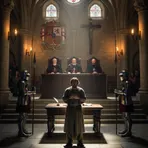
A court set up by the Spanish kings to find and punish people for not following Catholic beliefs

 1
8.7
1
8.7
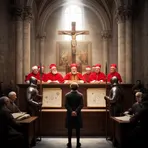
A court set up by the Catholic Church in Italy in 1542 to punish people for new religious ideas
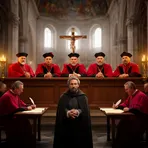
A Roman Catholic church group that judged people for wrong religious beliefs in Italy from 1542
Surface Forms
Morphology
Inquisition = inquiry (semi-transparent) = inquisit + ion
Formally built from the same root as 'inquiry'/'inquire' by suffixation, but the historical, institutional sense 'a tribunal for heresy' is specialized and not fully predictable from the base.
Etymology
The word Inquisition comes from Latin parts in- ('in') and quaerere ('to seek' or 'to ask'), so it originally meant a formal search or 'questioning'. That's why the historical Inquisition was a church-run, often harsh investigation into people's beliefs.