
Indian tapir
- noun
- /ˈɪndiən ˈteɪpɪr/
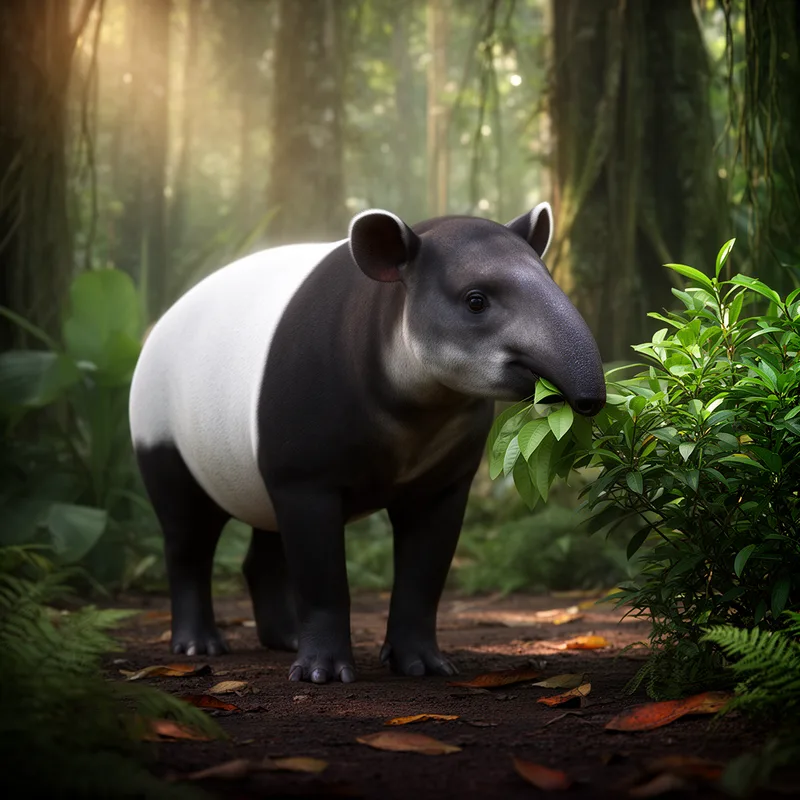
- The Indian tapir is easily identified by its striking black and white coloring.
Examples
-
We spotted an Indian tapir at the edge of the rainforest during our trip to Malaysia.
-
Conservation efforts are underway to protect the endangered Indian tapir in Sumatra.
-
The Indian tapir is an endangered species.
-
What a beautiful Indian tapir!
-
Conservation efforts are underway to protect the endangered Indian tapir in Sumatra.
-
The Indian tapir is easily identified by its striking black and white coloring.
-
We spotted an Indian tapir at the edge of the rainforest during our trip to Malaysia.
Synonyms

 3
8.2
3
8.2

A large mammal with a flexible nose that lives in tropical forests and is active at night

A large black and white animal like a pig with a short flexible nose that lives in Southeast Asian forests

A large mammal that eats plants with black and white skin living in forests in Malaysia and Sumatra
Surface Forms
Morphology
The noun phrase is directly compositional: an adjective denoting origin/association ('Indian') plus the noun ('tapir') yields a tapir associated with India/the Indian region. This adjective+noun pattern is regular and cross-linguistically common, so a B1 learner who knows both constituents can infer the meaning without prior exposure.
Etymology
The name Indian tapir may come from the animal name tapir, a local word early explorers used for a strange, pig-like animal with a short trunk. Long ago, 'Indian' could mean 'from the East Indies', meaning parts of Asia, so the name came to mean the tapir that lives in Asian forests, the large black-and-white mammal we know today.