
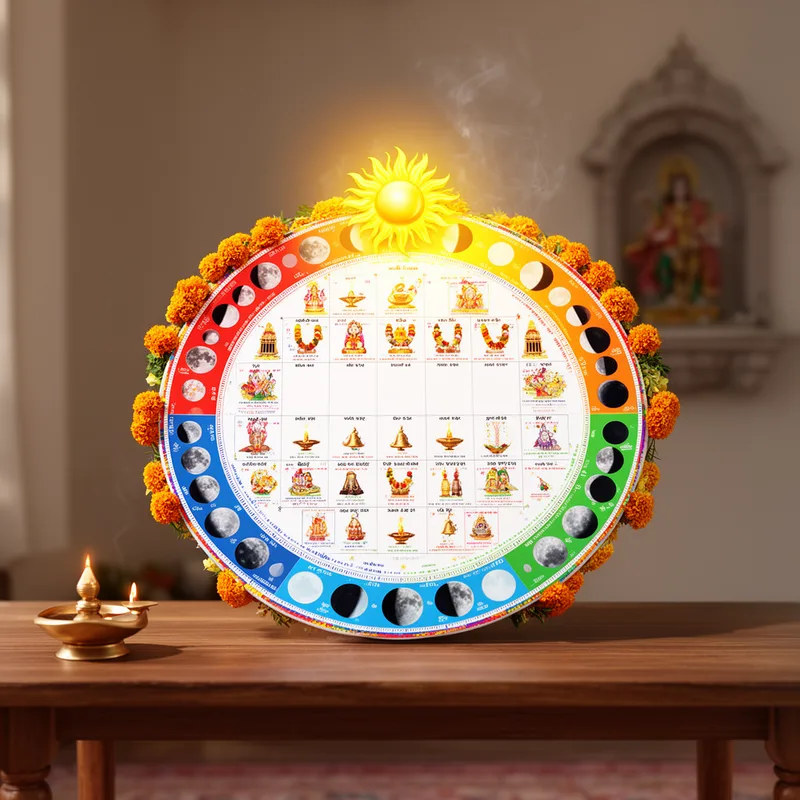
Hindu calendar
- noun
- /ˈhɪnduː ˈkælɪndər/
- Indian
- Many festivals are based on the Hindu calendar.
Examples
-
Many Indian festivals are scheduled according to the Hindu calendar instead of the Gregorian calendar.
-
Astrologers often consult the Hindu calendar to determine auspicious dates for weddings and ceremonies.
-
The Hindu calendar occasionally adds a leap month to keep the lunar months aligned with the solar year.
-
The Hindu calendar is essential for planning festivals.
-
Many festivals in India are based on the Hindu calendar, which follows both lunar and solar cycles.
-
The Hindu calendar is essential for determining the dates of important religious events and ceremonies in Hinduism.
-
According to the Hindu calendar, the festival of Diwali occurs on the darkest night of the month of Kartika.
Synonyms

 73
1.0
73
1.0

A system that divides the year into months, weeks, and days

A calendar that uses months based on the moon and adjusts years to match the sun
Surface Forms
Morphology
The meaning is directly and compositionally derived from 'Hindu' (related to Hinduism) + 'calendar' (a system for organizing years/months); an average B1 learner who knows both constituents will infer it refers to the calendrical system used in Hinduism for festivals and observances. This noun–noun combination is a common, cross-linguistic pattern (e.g., 'Islamic calendar', 'Gregorian calendar'), making the expression immediately comprehensible without prior exposure.
Etymology
Hindu calendar grew from watching both the moon and the sun: people counted months by the moon but watched the sun to know the seasons, so every few years people add an extra month to keep the festivals in the right season. That's why it is used to set the dates of religious 'festivals' and sometimes adds a 'leap month'.