

Hibiscus moscheutos
- noun
- Specialized
- Wild populations of Hibiscus moscheutos can often be found along the edges of marshes and ponds.
Examples
-
The Hibiscus moscheutos blooms in late summer, adding vibrant color to wetland gardens.
-
Gardeners value Hibiscus moscheutos for its large, striking flowers and ability to thrive in moist soils.
-
The Hibiscus moscheutos blooms beautifully in the summer.
-
I planted a Hibiscus moscheutos in my garden last spring.
-
Gardeners value Hibiscus moscheutos for its large, striking flowers and ability to thrive in moist soils.
-
The Hibiscus moscheutos blooms in late summer, adding vibrant color to wetland gardens.
-
Wild populations of Hibiscus moscheutos can often be found along the edges of marshes and ponds.
Synonyms

A tall plant with large rose-colored flowers that grows in salt marshes

A bush with large pink flowers that grows in salt marshes
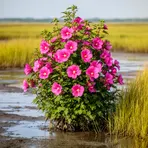
A showy shrub that grows in salt marshes and has large pink flowers

A plant with pink or white flowers that grows in salty wet ground

A tall flowering plant with large bright flowers often grown in gardens
Surface Forms
Morphology
Hibiscus + moscheutos
This is a Latin binomial: 'Hibiscus' clearly signals the plant genus so a learner who knows that word can infer it denotes a kind of hibiscus, but 'moscheutos' is not an English lexical item and gives no predictable information about the plant's appearance or habitat. Thus the construction is only partially compositional — the type is inferable but the specific meaning (swamp rose mallow, marsh habitat, showy flowers) is not — making it semi-transparent.
Etymology
Hibiscus moscheutos is the scientific name for the plant called the 'swamp rose mallow'; the first part, Hibiscus, marks it as a mallow and the second part, moscheutos, links it to its showy, rose-like flowers and marsh home. So the name helps you remember a big, rose-like mallow that grows in wet, marshy places.

