
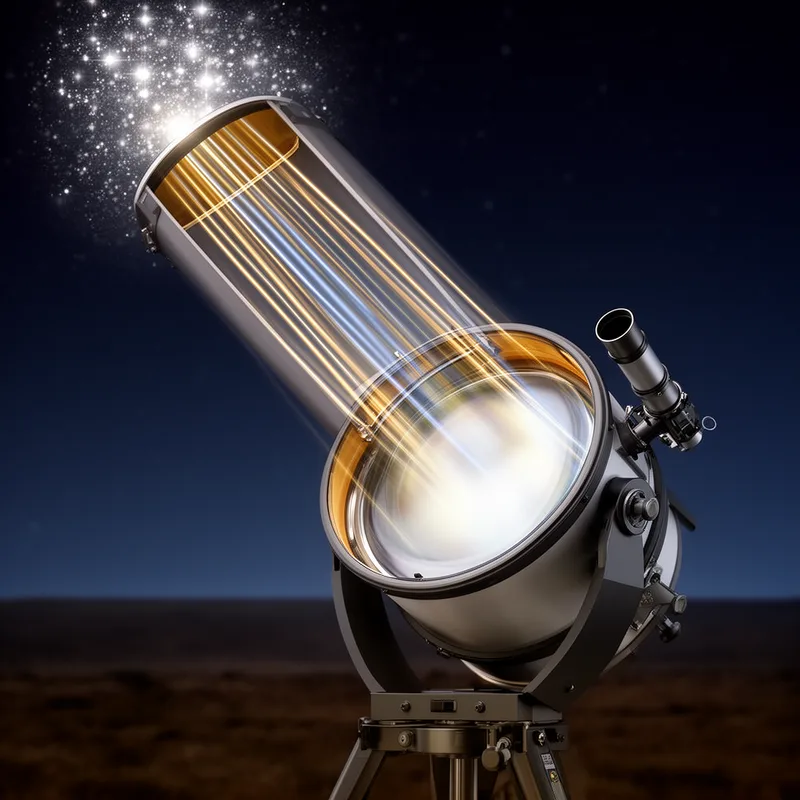
Herschelian telescope
- noun
- /ˈhɜrʃəliən tɛlɪˌskoʊp/
- Archaic
- William Herschel built a massive Herschelian telescope to observe new stars and nebulae in the 18th century.
Examples
-
Unlike modern reflectors, the Herschelian telescope uses a tilted mirror to send the image to the side.
-
The Herschelian telescope offers a unique viewing experience.
-
The Herschelian telescope was an innovative design that allowed astronomers to view celestial objects without a secondary mirror.
-
Many astronomers prefer using a Herschelian telescope for its design.
-
The scientist used a Herschelian telescope to observe distant galaxies due to its unique design.
-
With its slightly tilted mirror, the Herschelian telescope provided a clear view of the lunar surface.
-
Amateur astronomers often appreciate the Herschelian telescope for its simple construction and effective performance.
Synonyms

A telescope with a tilted main mirror that sends the image to the side to avoid mirror blocking light
How Complex
- Specialized

- Specialized
- Archaic
- Specialized
 1
5.5
1
5.5

- Specialized
1
6.7
5
7.6
Surface Forms
Morphology
Herschelian + telescope
The form combines an eponymous adjective (Herschelian — relating to Herschel) with 'telescope', so a learner who knows both constituents will understand it denotes a type of telescope associated with Herschel. The precise technical property described (a slightly tilted mirror directing the image to the side and eliminating a secondary mirror) is specialist information that cannot be derived from the constituents, making the expression only partially predictable.
Etymology
Herschelian telescope is named after the astronomer William Herschel, who used a large, slightly tilted mirror in his design. By tilting the mirror he sent the image to the side so he could look without a 'secondary mirror', so the name now means a reflecting telescope with the mirror angled to one side.