
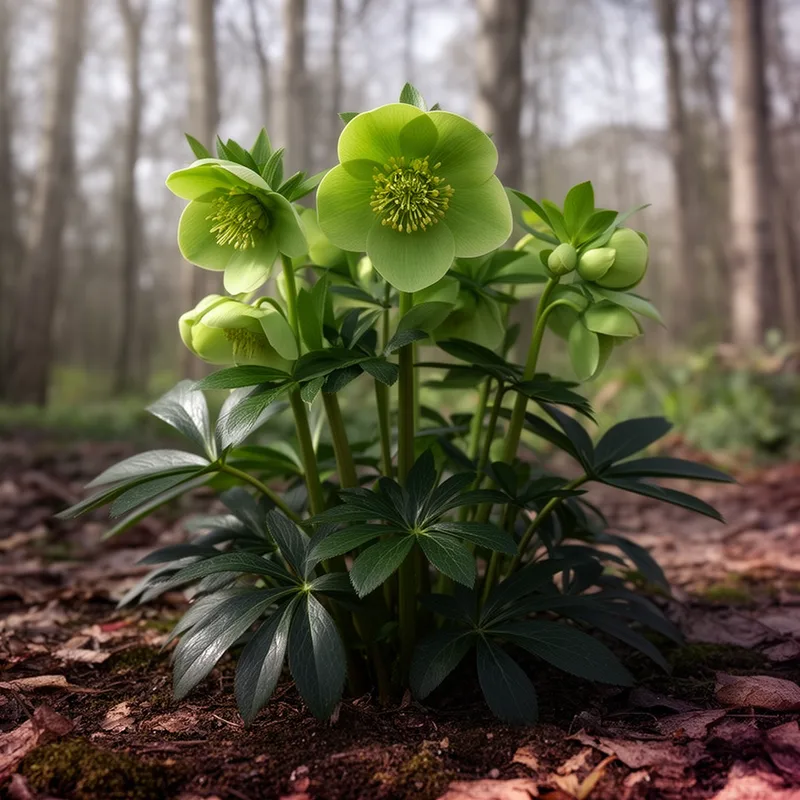
Helleborus viridis
- noun
- Specialized
- Unlike other hellebores, Helleborus viridis is easily identified by its green flowers and divided leaves.
Examples
-
The woodland garden featured a beautiful clump of Helleborus viridis in early spring.
-
I planted several Helleborus viridis in my garden.
-
Botanists recorded several specimens of Helleborus viridis growing along the forest edge.
-
The Helleborus viridis blooms beautifully in spring.
-
In the garden, the vibrant Helleborus viridis stood out with its unique green flowers.
-
During the workshop, we learned how to care for Helleborus viridis to ensure it thrives.
-
The natural habitat of Helleborus viridis includes shaded areas of deciduous forests.
Synonyms

 1
9.9
1
9.9

A plant with thick leaves that blooms in early spring and can be poisonous
A plant from Europe with green cup-shaped flowers and large divided leaves that is poisonous
Surface Forms
Morphology
Helleborus + viridis
This is a botanical Latin binomial combining the genus name Helleborus with the specific epithet viridis (Latin for 'green'), so a learner who knows both constituents can straightforwardly interpret it as the 'green hellebore'. The construction is compositional (genus + descriptive modifier) and therefore predictable to anyone familiar with the parts, even though many B1 learners may not know Latin vocabulary in practice.
Etymology
Helleborus viridis comes from old plant names: helleborus is the old word for hellebore plants, which people long ago used as a strong medicine or even a poison, and viridis is Latin for 'green'. So the name literally means a green hellebore and explains why this species has green flowers.