

Helleborus orientalis
- noun
- Specialized
- The Helleborus orientalis blooms beautifully in early spring.
Examples
-
Gardeners recommend planting Helleborus orientalis under deciduous trees for best results.
-
The subtle beauty of Helleborus orientalis makes it an excellent choice for woodland borders.
-
Helleborus orientalis is prized for its early spring flowers in many shade gardens.
-
Many gardeners love the Helleborus orientalis for its unique flowers.
-
Helleborus orientalis is prized for its early spring flowers in many shade gardens.
-
Gardeners recommend planting Helleborus orientalis under deciduous trees for best results.
-
The subtle beauty of Helleborus orientalis makes it an excellent choice for woodland borders.
Synonyms

 1
9.9
1
9.9

A plant with thick leaves that blooms in early spring and can be poisonous
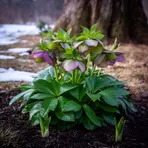
A garden plant with thick green leaves and purplish green flowers that blooms in early spring
Surface Forms
Morphology
Helleborus + orientalis
This is a Latin binomial: the first element is a scientific genus name and the second is a non-dictionary Latin epithet, so a B1 learner who knows the surface forms would not be able to derive the plant description or common name from them. Even if 'orientalis' is glossed as 'eastern', that only signals geographic origin and does not yield the sense 'Lenten rose' or the detailed botanical properties, so the overall meaning is not compositionally predictable for typical learners.
Etymology
Helleborus orientalis comes from Latin; orientalis means 'eastern', so the name points to where the plant came from. One popular image is the 'Lenten rose' because it makes rose-like flowers in early spring around Lent, and that's why gardeners call it that today.