
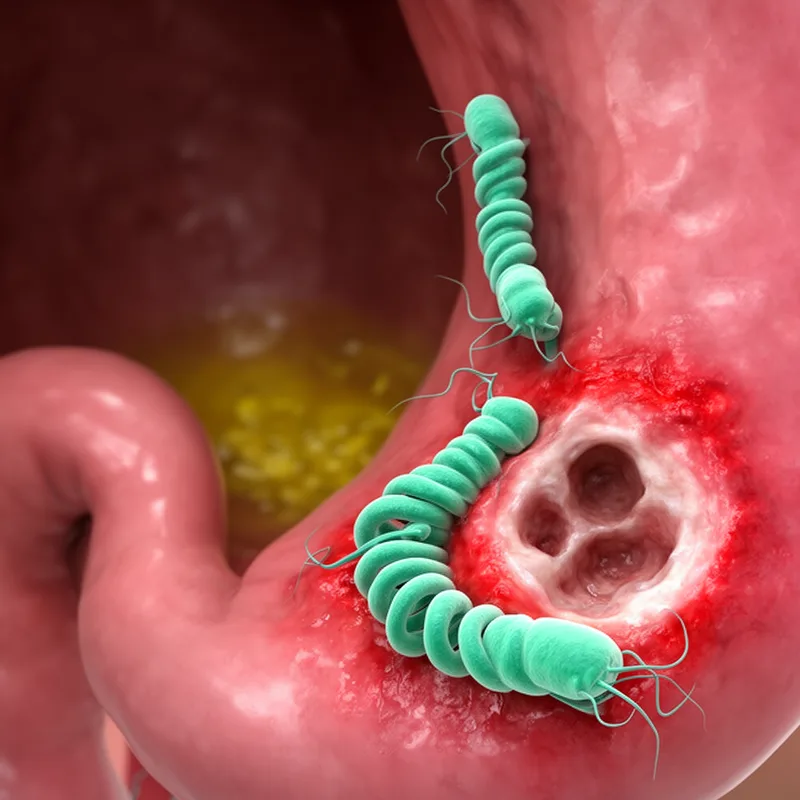
Helicobacter pylori
 1
3.7

- noun
- /ˌhɛlɪkoʊˈbæktər paɪˈlɔri/
- Specialized
- The discovery of Helicobacter pylori was a breakthrough in understanding the cause of stomach ulcers.
Examples
-
Doctors often prescribe antibiotics to eradicate Helicobacter pylori from the stomach.
-
Doctors often test for Helicobacter pylori in patients with stomach issues.
-
If left untreated, an infection with Helicobacter pylori can lead to chronic gastritis.
-
Is Helicobacter pylori dangerous?
-
If left untreated, an infection with Helicobacter pylori can lead to chronic gastritis.
-
Doctors often prescribe antibiotics to eradicate Helicobacter pylori from the stomach.
-
The discovery of Helicobacter pylori was a breakthrough in understanding the cause of stomach ulcers.
Synonyms
 2
6.3
A germ that infects the stomach lining and often causes ulcers and stomach pain
Surface Forms
Morphology
Helicobacter + pylori
This is a Latin binomial (scientific species) name, not a compositional English phrase, so its medical sense ('a spiral bacterium of the stomach') cannot be derived from the surface tokens. Even if a learner recognizes 'bacter' as related to bacteria, the specific association with the stomach and disease (pylori) requires specialized knowledge, so it is not predictable to a B1 learner.
Etymology
Helicobacter pylori comes from parts that describe the microbe's shape and home; helico means 'spiral', bacter means 'bacterium', and pylori points to the lower part of the stomach, so the name helps you remember it is a spiral-shaped bacterium that lives in the stomach.